Two men roped together, and one working leg between them
At six thousand metres they had no anchor, so they tied themselves to each other and trusted that. Then they began to slide, and did not stop for 200 metres.
They were not carrying the one thing that mattered: an anchor point.
Under a metre of powder snow they had probed a long section without finding hard ice or rock to place protection in. So they tied themselves to each other, and trusted each other.
At around ten at night on 7 November 2025, at close to six thousand metres on the north face of Mount Reduomanyin, the two men on that single rope began to slide.
Two hundred metres later, both were lying on an ice slope. The first had a broken right foot. The second was at the bottom of a crevasse nearly ten metres deep, with both legs broken and a fractured thoracic vertebra.
The radio would not reach the camps below. There was no light anywhere beneath them; the whole flank of the mountain was one dark patch.
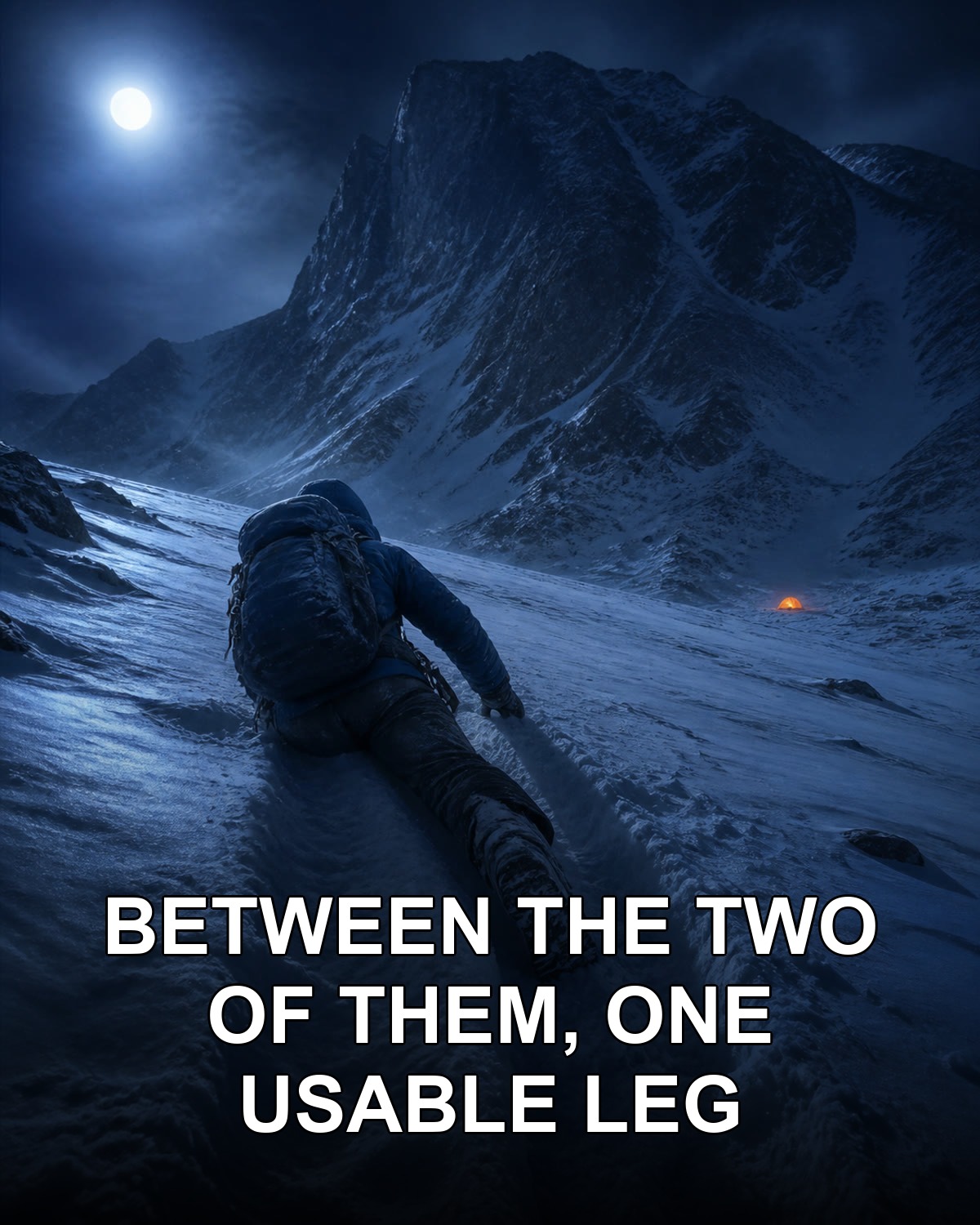
Between the two of them, they had exactly one usable leg.
Reduomanyin stands 6,112 metres, at the meeting point of the Riwuqie and Moxi streams, in the city of Kangding, Garzê Prefecture, Sichuan. It is one of the satellite peaks of Mount Gongga — the king of the mountains of Shu, 7,556 metres — and from its summit you look straight across at that king.
For long-distance hikers the name is familiar in a different way: the Riwuqie pass on the mountain's north-western flank, at 4,920 metres, is the highest point and hardest stage of the Gongga great circuit. Every season thousands of people shoulder packs over it, look up at the mountain, and walk on.
Climbing it is another matter entirely.
The Japanese reached the summit first: the Hokkaido University climbing team, in September 1999, by the west face. In time a reasonably settled commercial route developed along the north-west ridge — the one most climbers take.
The north face is not that.
The north face is near-vertical, averaging around fifty-five degrees, with sections up to eighty. Rockfall. Fractured ice. In 2011 the pair of Zhou Peng and Yan Dongdong — known in Chinese climbing circles as Freedom Spirit — opened a route straight up the central spur and named it "In Memory of Chris". It was the first ascent from that direction.
Fourteen years later, two more men looked at the north face and wanted to draw a line of their own.
The first was Zhu Peng (朱鹏), from Chongqing, where he ran an outdoor company, with three or four years of technical climbing behind him and a number of peaks above five thousand metres. He had fallen once before: in 2022, on Mount Bailang (5,072 m), he slid more than ten metres. After that he went back and learned the techniques properly.
The second was Kou Qiaoqiao (寇侨侨), the older of the two, a former trail marathon athlete working in the outdoor industry in Yunnan. People called him Brother Kou. What everyone would later mention about him was not a record but the fact that he had kept up a heavy training regime, consistently, for years without a break.
On 31 October 2025 the two men arrived in Kangding. Then it snowed for three days straight. They sat and waited.
Not until 4 November could they get into the mountains. On the 5th they reached Camp 1 near the glacial lake. On the 6th they spent the whole day on the Reduomanyin glacier, its surface criss-crossed with cracks and shining a pale blue. Late that afternoon they reached Camp 2 and pitched a tent.
The wind blew all night.
On the morning of 7 November, because of the wind, they pushed their start back to half past five.
They did not plan to sleep high. So the tent, the sleeping bags, most of the heavy gear — all of it stayed at Camp 2.
That is an ordinary calculation in light-and-fast climbing: move quickly, summit, descend in the day. It also meant that everything keeping them warm was sitting in a place that grew further away with every step.
Past the ice-tower forest and the crevasse field, they entered the north face. About a third of the way up they traversed right some fifty metres, then followed a runnel straight upward. Their new line took shape from there.
At around seven in the evening they reached the 6,112-metre summit.
The sun had gone. To the north the Gongga massif stood dark against the last of the light. There was nothing on the summit to sit on, nothing to break the wind.
Half an hour later they started down.
They descended by the book: place an ice anchor, throw the rope, rappel about fifty metres, then start again. Eight or nine times.
Then the snow changed.
Under their feet there was no longer ice but powder, loose, a metre deep. Nothing driven into it would hold. No ice, no rock, means no anchor station.
The two of them looked down. Their headlamps reached only a few metres. Beyond that, snow and darkness merged into one grey plane with nothing for the eye to fix on and judge distance by.
In the dark, the foot of the face seemed close.
That was where they got it wrong.
They switched to a faster method: rope the two of them together and walk down, trusting that if one slipped the other could hold him. What deceived them was the angle and the light. Looking down at night from where they stood, every distance contracts.
In reality there were still close to two hundred metres below them.
At around ten at night, the two men began to slide. Almost simultaneously — because the snow under both of them held neither.
The face was too steep for them to stop. On the way down they flew over the mouths of two crevasses, dropped, and rolled on into a band of rock.
Two hundred metres of vertical drop. The height of a sixty-storey building.
Both were wearing helmets. That is the reason there is a rest of this story.
When everything stopped, Zhu Peng felt no pain. The human body, after a large enough shock, often responds that way in the first few minutes.
He sat up and looked around for his partner. Nobody there.
He shouted.
Some minutes later a voice answered from somewhere underground, asking: where is this, who are you.
Kou Qiaoqiao had fallen into a crevasse nearly ten metres deep, and was dazed from the impact.
Only then did Zhu Peng look down at where he was sitting.
The lip of the crevasse was about twenty centimetres from his body. Beyond it his light did not reach the bottom — only a narrow dark seam, and his friend's voice rising out of it as if from under the earth.
The rope joining them was fifty metres long. It was precisely those fifty metres of slack that kept him from being dragged down after his partner.
Then the pain arrived. His right foot was broken — later diagnosed as a fractured talus — and his left arm was damaged too.
Down in the crevasse, Kou Qiaoqiao called up that both his legs were broken and that he was bleeding badly.
Zhu Peng tried the radio. Nobody answered.
He added up what the two of them had left: one left leg and one right arm.
Zhu Peng called down into the crevasse. The gist: my right foot is broken, I cannot pull you out. Do not sleep down there, wrap the blanket tight around yourself. I am going to untie and crawl back to the tent for help. Hold on until they come.
Then he untied the rope.
His headlamp had been ripped away during the slide. He moved by moonlight and by feel.
He could not walk. He crawled.
To keep the broken foot from being jolted, he held the right leg up off the snow and pushed himself along with the left leg and the right arm, in short pulls. The position exhausted him quickly. When crawling wore him out he rolled onto his back and lay a while. When thirsty he scooped snow into his mouth — knowing perfectly well what that does to the airway, and having no other option.
The temperature that night was well below freezing.
Under the moon the snow was one even white: no path, no footprints, no landmark of any kind. Behind him a dragged trail faded out. It was the only thing on the whole flank of the mountain proving a person was passing through.
After about four hours he stopped, used his ice axe to dig a snow hole and got in. A snow hole blocks the wind and slows the loss of body heat. But it was too shallow, and he shook violently.
He rested exactly five minutes, then crawled out and went on, reasoning that as long as he kept moving he would freeze more slowly.
Crawling flat to the ground blocked his line of sight, and at some point he lost his bearings without knowing it. Two hours later he stopped and dug a second hole. Then he realised he had drifted off line, and corrected gradually as he crawled.
The next stretch was a canted slope, where there was no way to keep the broken foot from being jarred. Two more hours passed. He could not take it.
He dug a third hole, lay down in it, and pulled snow over himself.
He gave up. He intended to bury himself there.
Inside the hole the wind no longer reached him. Snow covered his face and chest, and the last sounds faded out. On all four sides it was quiet, white and soft.
That was when he began to see things that were not there, and stopped feeling cold.
Losing the sensation of cold is not a good sign. It is the point at which hypothermia has gone some distance.
Lying there he thought about the promise he had made down into that crevasse a few hours before, and about how people would abuse him if this ended up in the news.
What was left in the end was only this: dying this way was not acceptable to him.
He crawled out of the hole.
Some time later there was a faint speck ahead that looked like a tent. He crawled about another hour and the speck grew. Only then did he dare believe it was not a hallucination.
The sky began to pale in the east. The tent sat exactly where they had left it two days before, swelling in the wind and collapsing again.
At seven in the morning on 8 November, Zhu Peng got inside the tent at Camp 2.
The distance was about one kilometre. He had crawled for close to nine hours.
The first thing he did was reassemble the radio, smashed apart during the slide. With it back together, he called base camp.
No answer.
He called Kou Qiaoqiao.
No answer either.
He called again. And again. From seven until eight in the morning he kept pressing the button and speaking into a machine that returned nothing. Each time he released it the set gave back a burst of static, then silence.
Then he wept.
Recounting it afterwards, he said plainly what few people are willing to say: that to claim he had crawled all night purely for his friend would not be true — his own survival instinct was in there too. But one fact he would not trade away: between seven and eight that morning he cried, because he had become certain his friend was dead.
He had just spent nine hours crawling one kilometre. And he believed he had come back too late.
The truth was otherwise.
Kou Qiaoqiao, at the bottom of the crevasse, had heard all of it. His set was receiving but could not transmit.
Which means that all night he lay down there listening to his friend calling him, with no way to say he was alive.
All four sides were ice, drawing heat away through his back, his legs, everywhere that touched. The mouth above was a narrow strip of light, and all night it grew no wider.
So he decided to climb out himself.
Both legs broken. A thoracic vertebra broken. Back injured.
He drove his ice axe into the crevasse wall, hooked a hold, and hauled that body up nearly ten metres of vertical ice.
Nobody witnessed that part. It is only known that he did it.
Out on the ice surface, he lifted his phone and recorded a clip for himself. In it he says, in a very level voice, that they slid the night before, that he fell down there, that he is broken in several places, that his team called on the radio and assumed he was gone, that down there the set could only receive — and that he has got himself out.
Close to eight in the morning, up at Camp 2, Zhu Peng's radio reached base camp.
He reported it in the worst terms he believed accurate: possibly one dead and one badly injured, possibly both badly injured, because his partner was not responding.
Then he gave the rescue team one instruction: when they got up there, whatever state his friend was in, go and pull that man out first.
About a minute later, the radio sounded. Kou Qiaoqiao's set had managed to transmit.
The voice on the other end said he had already crawled out of the crevasse.
At midday on 8 November, the rescue team from base camp reached Camp 2. They found Zhu Peng first, then located Kou Qiaoqiao on the snow slope and brought him across to his friend.
The two looked at each other and both laughed. Simply because both were alive.
One of the rescuers told them, in effect, that if they had been a little less fit, or if any one factor had been missing, there was a better than ninety per cent chance the team would have been carrying two bodies down that day.
The terrain from Camp 2 downward is a mix of glacier, scree and crevasse. In many sections a stretcher was unusable; in places they had to wrap the injured in sleeping bags and drag them.
From two in the afternoon on the 8th they began bringing the two men down. They were on the move for close to twenty hours. In the early hours of 9 November both reached the bottom and were taken to hospital in Kangding. Kou Qiaoqiao was later transferred to an orthopaedic trauma hospital in Chengdu, Zhu Peng to Chongqing.
The cost of the rescue, according to Chinese press reports, was around sixty thousand yuan per person.
The talus in Zhu Peng's right foot had to be fixed with screws and put under traction. One painkiller injection a day. Months after the accident, neither man's course of surgery was finished.
Asked about it, Zhu Peng would not accept the label of hero, nor of reckless. He said he was not an amateur. Then he offered a ratio: ninety per cent luck, ten per cent will.
He itemised the luck very specifically. The radio broke apart and still worked when reassembled. The first two crevasses they flew over without dropping into. And each man was left with exactly one usable part of his body — he still had a leg to crawl on, his friend still had two arms to climb with.
A man with two broken legs and a broken thoracic vertebra, at the bottom of an ice hole nearly ten metres deep — and he climbed out himself. To understand why climbers go quiet when they hear that sentence, you have to know what that hole is, and what happens to a body when it starts sliding on snow.
The crevasse
A glacier is not a block of ice sitting still. It flows — very slowly, but it flows. When that flow creeps over a change in gradient, the surface is stretched and splits. That split is a crevasse. Some are a few metres deep, some tens of metres, with near-vertical walls that narrow as they go down.
What makes them dangerous is snow. Snowfall covers the mouth and forms a lid that looks exactly like ordinary snow surface. The person walking over it sees nothing until the lid gives way.
Once a person is in a crevasse, getting out alone is close to impossible: the walls are slick, the body is often wedged tight at the narrow section, and body heat is drawn away fast because all four sides are ice. In the textbooks, a person who falls into a crevasse waits to be hauled out by his rope team with a pulley system. He does not climb.
Which is why a man with two broken legs and a broken thoracic vertebra chipping his own way up nearly ten metres of crevasse is, literally, not in the book.
The slide
People tend to assume snow mountains kill by avalanche or by altitude. In fact, in Chinese mountaineering accident statistics, losing the route is the most common type of accident, while falls and slides account for only around one in ten incidents — but for more than half of the fatal ones.
The reason lies in physics. On a hard snow slope of forty degrees, a sliding person needs only a few seconds to reach a speed at which self-arrest is no longer possible. From the third second onward, every ice-axe braking technique stops working. After that, living or dying depends on what is at the bottom: a deep snow field, or a band of rock, or a crevasse.
One detail in this case is worth setting out on its own, because it is a real technical lesson rather than generic advice.
Roping together on a glacier exists to protect against crevasse falls: one person drops through, the others hold him. But that method has a condition — the person holding must be standing on ground with friction, and must be able to arrest in time.
On a steep face covered in powder snow that holds nobody, that condition disappears. At that point the rope is no longer the thing that saves two people. It is the thing that turns two people into one mass falling together.
That night on the north face, the rope did both jobs. It pulled both men down two hundred metres. And its own fifty metres of slack was what kept one of them from being dragged into the crevasse after the other.
Two small notes, because these are the two points most often got wrong as this story spreads online.
First: "a two-hundred-metre slide" is the vertical drop, not the distance rolled across the face. The actual path their bodies travelled was longer than that figure.
Second: the man who opened the north face route in 2011 was Zhou Peng (周鹏), climbing with Yan Dongdong — not the Zhu Peng (朱鹏) of this story. They are two different people whose names sound nearly identical in Chinese. Many retellings have merged them into one.
Sources
- https://news.qq.com/rain/a/20251112A049N200
- https://m.cqcb.com/feidian/2025-11-12/6005862.html
- https://news.qq.com/rain/a/20251118A03NLH00
- https://news.ifeng.com/c/8oNf2KcVsoT
- https://caa1993.org.cn/content/20/2998.shtml
- https://zhuanlan.zhihu.com/p/1989760581989851982
- https://www.sohu.com/a/280178671_100256540
- https://baike.baidu.com/item/滑坠/67387038
AI-generated illustration. Not a photograph of the actual incident.