The day they held his memorial service
In May 1982 a family in Japan buried a twenty-six-year-old climber lost on a Sichuan ice peak. Thirty-two people have reached that summit. Thirty-seven have died on it.
A family in Japan held a memorial service for a man who was still alive.
The service was on 19 May 1982, for Matsuda Hiroya, twenty-six years old. In those same days, on the other side of the sea, Matsuda Hiroya was still crawling down an ice slope in Sichuan. He had been crawling for eighteen days.
Mount Gongga stands 7,556 metres high. It is the highest summit in Sichuan, and the Chinese call it the king of the mountains of Shu.
For climbers, that number is a trap. It sits below eight thousand metres — the line everyone treats as the boundary of the death zone — but the difficulty does not sit below it. The faces are near-vertical. The glaciers are laced with crevasses. The weather turns in a matter of minutes.
One figure says it better than any description. As of 2017, roughly thirty-two people had reached the summit of Gongga.
Thirty-seven had died there.
More dead than successful.
In March 1982, the Ichikawa Sangakukai climbing club of Japan entered the range from the Hailuogou side, aiming at Gongga's east face.
There were seven of them. Matsuda Hiroya was among the youngest.
On 29 April, two were chosen for the summit push: Matsuda Hiroya and Sugawara Shin. The rest fell back to the lower camps.
To move fast they carried very little — some chocolate, a few bars of field rations, a little hot water.
At around one in the afternoon they reached a point only a short distance below the top.
From where they stood, the line of snow along the summit ridge was already clearly visible.
Fifty metres to go.
Then the sky came down.
Cloud rolled in, the wind hit, the snow came. Visibility dropped below one metre — and at that altitude, one metre means you cannot see the man roped to you.
The wind arrived from every direction at once. The snow did not fall; it flew horizontally and struck the face like sand. The noise of it buried every other sound, including a man's own shouting.
The two of them dug a snow hole and crawled in.
Outside it was close to minus thirty degrees.
Inside the hole there was nothing by which to measure time. The cold no longer arrived from outside but seemed to rise from inside the bones, and every few minutes a man had to move his fingers to confirm they were still there.
They lay in the snow hole until the following morning. The storm had not eased at all.
They decided to go down.
On the way down they reached the camp by radio one last time. Matsuda reported that the wind and snow were too strong and that they had lost the route.
Then the radio went dead. Most likely the battery.
From 1 May, the two men were out of contact entirely.
Below, a search was organised — a sweep line across the glacier. The remaining team members, local people, porters, Han and Yi alike, all went up.
The weather was too bad to do more than that.
A week passed. Nothing.
Then the expedition made the decision nobody wanted to make: stop the search, withdraw from base camp.
Before leaving, they did something very human. They gathered what material they could find nearby, wove it into a wreath, set it down at base camp, and held a memorial for their two teammates on the spot.
They left a note.
The note said they would never forget the two of them.
Then they walked down the mountain.
At that exact moment, higher up, the two men were still alive.
They were tied to each other with a single rope, ice axes in hand, feeling out one step at a time down the slope.
That descent took everything from them, in the most literal sense.
The water ran out. They sucked on snow in small amounts, and their stomachs began to protest.
The rations were gone on the first day. They bit off strands of down escaping from their jackets so there would be something in their mouths.
One man's ice axe fell into a crevasse during a slip. A trekking pole snapped.
Matsuda's left boot came off as he stepped across a crack. He tore apart his camera case and wrapped the leather around his bare foot.
Sugawara lost his gloves while hauling on the rope. His hands swelled and turned purple.
In the end, the only thing left between the two men was the rope tying them together.
Then a tent appeared in front of them.
Through fogged memory, both recognised it: Camp 1, at roughly five thousand metres.
There was no food left inside.
Sugawara sat down against the ice wall. He told Matsuda he needed half an hour's rest.
Half an hour, no more.
Matsuda was spent as well. He closed his eyes.
When he woke, the place where Sugawara had been sitting was empty.
He walked around the camp calling. He searched for two hours.
Later it was believed that Sugawara, severely dehydrated and hypothermic, had wandered off while no longer lucid and fallen into one of the crevasses nearby.
He was never found.
From there Matsuda Hiroya went down alone.
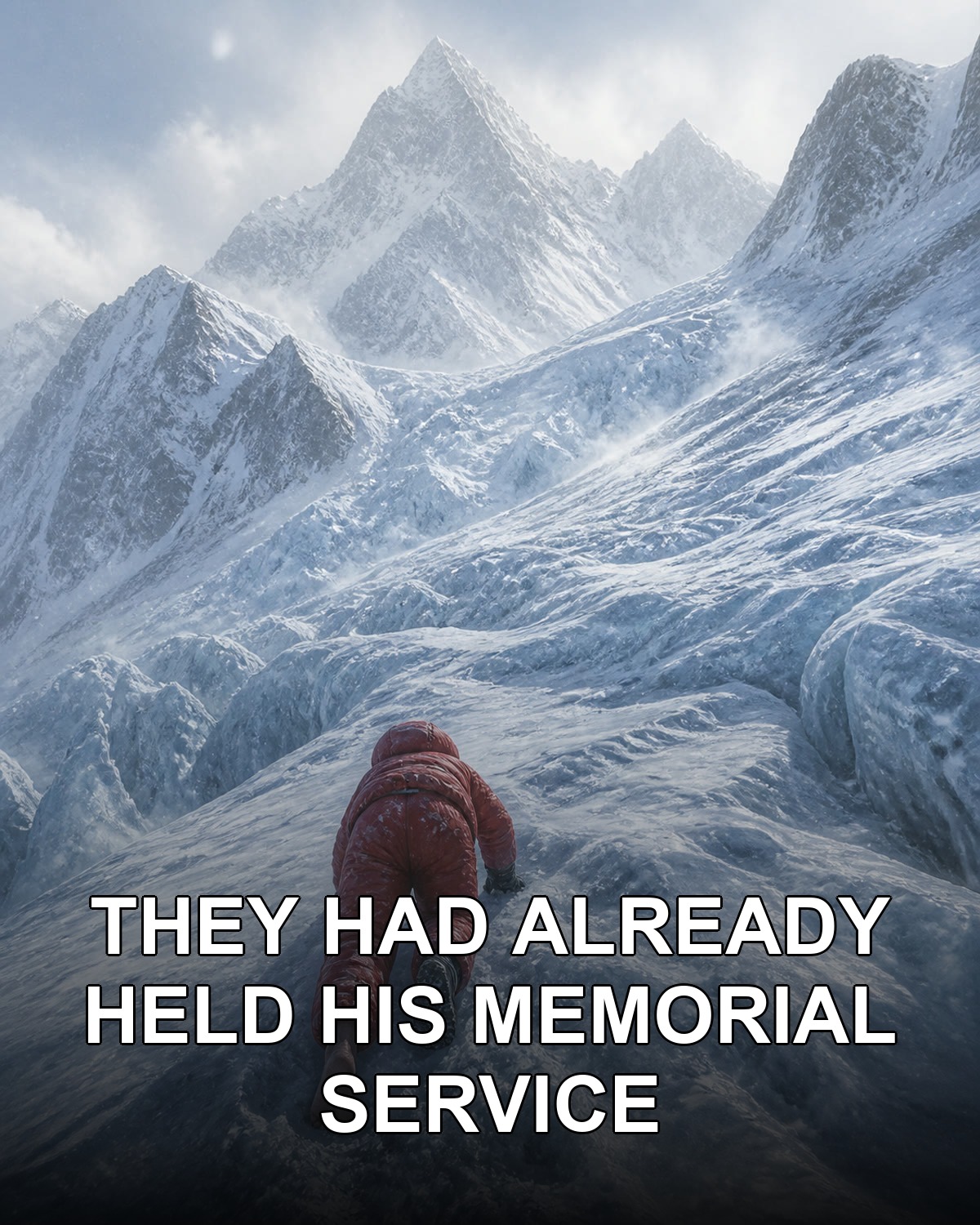
This stretch was a forest of ice towers and steep ice slope. His hands and feet had lost nearly all sensation, so he could no longer walk — he gripped the rope with both arms and let his body slide down in short stages.
Every metre of descent meant stopping and waiting for the pain to pass.
The ice under him was slick and blue, so clear where it was thin that he could see the dark beneath it. There was no colour anywhere but white and blue, and no sound but the sound of his own body sliding on ice.
He lost his balance and struck the ice wall repeatedly, hard enough to crack ribs.
Then he reached the forward camp.
The tent had been torn apart by the storm. But in the wreckage there were a few frozen tins and half a sack of rice.
He lit a flame and burned the leg of his own trousers to warm a tin.
But days of hunger and cold had left his stomach badly ulcerated. He could not swallow the food. He managed only a few mouthfuls of the liquid in the tin.
Even that was enough to leave him satisfied. It was the first warm thing to enter him in many days.
The heat travelled as far as his throat and stopped there; the rest of him stayed cold. Wind slid in through the split fabric. He lay listening, not knowing the hour, no longer able to count how many nights had been like this.
That night he slept.
The next morning he moved again, heading for base camp. He believed his teammates were still there waiting for him.
When he left Japan he weighed seventy kilograms.
By now he was under forty.
His face was blistered with frostbite. His beard and hair had frozen into plates. His vision had blurred from dehydration and from the glare off the snow.
Looking back, he could see that the track he had just made was no longer white.
There was exactly one thought left in his head: stay alive, so he could find his teammates.
Then he reached base camp.
The camp was empty. The tents were torn. Not a single person.
One side of the tent fabric had come loose and slapped in the wind. He stood and listened for a while, waiting for someone to call his name, and nothing came. Everywhere were the traces of people who had been here recently and had gone.
Then he saw the wreath.
And the note his teammates had left — the note saying they would never forget him.
Only then did he understand: they had stopped looking for him.
His legs gave way. His consciousness began to go.
In and out of awareness, he seemed to see several human figures.
He was not hallucinating.
They were four Yi men gathering medicinal herbs on the mountain: a father and son, Mao Guangrong and Mao Shaojun, and an uncle and nephew, Ni Minquan and Ni Hongjun.
They came closer, and all four stopped where they stood.
Not one of them could say anything. The man on the ground was in rags, and it took a long look before they dared believe he was alive.
In his notebook there was a name: Matsuda Hiroya.
The four of them realised this was the missing member of the Japanese expedition.
The date was 20 May.
Nineteen days had passed since he lost contact.
The place they found him was the Chengmendong area, on the tongue of the Hailuogou glacier, at roughly 2,900 metres.
From just below the summit, he had brought himself down to there.
The four men carried him into an abandoned hut nearby, built a fire, and cooked for him. Early the next morning Mao Shaojun and Ni Hongjun ran down the mountain to raise the alarm — it took one of them more than nine hours to reach anyone.
The nearest hospital sent a rescue party up into the mountains that same night. They walked for more than ten hours in the rain.
On the evening of 21 May, Matsuda Hiroya was brought to a hospital in Luding, then transferred on to Chengdu.
By the time he came out, in addition to widespread tissue death from frostbite, he was carrying more than ten complications at once: septic shock, lung infection, a perforated stomach, blood poisoning.
Any one of them was enough to kill him.
During surgery, his heart stopped at one point.
After more than forty days of emergency care, he lived.
But he lost both legs permanently, and almost all of his fingers. Only part of a thumb and an index finger remained.
On 12 July, Matsuda Hiroya boarded a plane home to Japan.
Before leaving he said a line that would be repeated many times afterwards: that he was Japanese, but could also say he was Chinese — because the blood in him now was Chinese blood.
It was not a flourish. During his treatment he received 12.7 litres of transfused blood, donated by seventeen people, Han and Yi.
That autumn, the Japanese expedition returned to Gongga to search for Sugawara Shin's body. They found nothing. On that trip, one member of the party died of altitude sickness.
In 1983, Matsuda Hiroya, fitted with prosthetic legs, came back to the town of Moxi with gifts, to find and thank the four men who had saved him. In 2002 he returned to Hailuogou again, with his mother and his older brother.
In 2019, Mao Guangrong — the first man to see him lying in the snow — was diagnosed with oesophageal cancer. Hearing of it, Matsuda wrote, and enclosed photographs of himself, exactly as the old man had asked.
In an interview, the old man said something strange. He did not talk about having saved a life. He said that either way it had been too late — he used to dig for herbs on that slope often, and if only he had found the boy sooner, the boy would not have ended up disabled.
Hailuogou today is a glacier park.
The route along which they carried Matsuda Hiroya down that year has been made into a visitor path, and it carries his name.
The old base camp — the place he crawled to, where he saw his own funeral wreath and collapsed — is now the park's Camp 3.
Tourists walk past it every day.
Three questions usually follow this story.
Why a mountain of "only" seven thousand metres kills more than it lets through. A mountain's difficulty does not lie in its height but in what you have to cross to get up it. Much of the east face is climbing on hard ice, not walking on snow. Below it are glacier and moraine, a surface that changes with the season. Gongga also stands alone at the eastern rim of the plateau, where moisture off the lowlands is thrown straight against its flanks, so a clear sky can turn into a whiteout before a team can retreat a single camp. Climbers rank Gongga alongside the eight-thousanders for difficulty, and the ratio of thirty-two summits to thirty-seven deaths is a consequence of that, not a random number.
Why frostbite ends in amputation. At close to minus thirty degrees, the body prioritises the heart, lungs and brain. It does this by constricting the blood vessels in the hands and feet, accepting the sacrifice of the outermost parts. When blood stops arriving, the water in the tissue freezes and the cells fail. Warmed early, most of that damage can still recover. But when the state persists for days — and Matsuda was in it for nineteen — tissue starved of blood that long dies outright, and dead tissue becomes a route for infection to travel inward. At that point amputation is no longer a treatment for a foot or a finger; it is the only way to keep the rest of the person.
Why Matsuda lived and Sugawara did not. This is the hardest question, and the honest answer is that nobody knows for certain. All that can be done is to name the differences.
The first is altitude. Both were descending, but Sugawara stopped at Camp 1, around five thousand metres. Matsuda kept going, and every hundred metres of descent means slightly denser air and a slightly higher temperature. What people call "getting lower" is really this: each passing hour is less severe than the one before it.
The second is the will to keep moving. Severe dehydration and hypothermia confuse a person before they fell him — the most dangerous stage is the one where you can still walk but no longer know where you are going. Sugawara entered exactly that stage. Matsuda held one thought and would not let go of it: get down, find the others. A goal simple enough that a failing mind could still keep hold of it.
The third, and it should not be dressed up, is luck. He crawled onto precisely the slope where four Yi men gathered herbs, and arrived on precisely the day they came. A few days either way and nobody would have passed there at all. Mao Guangrong himself, almost forty years on, still said he had found the man too late. Earlier, and Matsuda would not have lost his legs. Later, and there would be no story.
A note on the numbers. The height of Gongga is given differently by different sources: most say 7,556 m, some 7,508.9 m. This account uses 7,556 m. As for "fifty metres from the summit", that comes from the expedition's own account — an estimate by two men standing in a storm, not a measurement. Recording it as they told it, and recording the discrepancy with it, is more honest than picking one tidy figure.
Sources
- Baidu Baike, entry for Matsuda Hiroya (松田宏也)
- Japanese-language Wikipedia
- Ganzi Daily
- china.com.cn
- Sohu (2019, report on the letter sent to Mao Guangrong)
AI-generated illustration. Not a photograph of the actual incident.