Four hundred metres below the summit, he turned around
Three years of preparation, and less than four hundred metres left to the top of the world. Then Fan Jiangtao saw someone lying in a hollow in the rock.
Less than four hundred metres below the summit of Everest, Fan Jiangtao walked past a hollow in the rock and saw a person lying on their side on the ground.
He had spent three years preparing for those four hundred metres. It was twenty past eight on the evening of 18 May 2023, and he was standing at roughly 8,450 metres on the south side of the mountain.
There is a line on Everest that every climber knows and nobody treats as a figure of speech: above eight thousand metres, there is no rescue.
It is not cruelty. Up there the air is so thin that, in Fan Jiangtao's own words, simply lifting a water bottle is enough to leave you exhausted. Bringing a person who can no longer walk down out of that zone usually takes four to six strong people.
That night, on that slope, there were two.
Fan Jiangtao was thirty-nine, leader of the Hunan provincial mountaineering team — a team he had built himself. Everest was the first link in the team's plan to climb the highest summit on each of the seven continents.
The second man was Xie Ruxiang, more than a decade older, a veteran climber, formerly captain of the Shanying mountaineering club at Peking University — one of the oldest climbing institutions in China. He had been climbing since the early 1990s.
Both were with their own Sherpa guides. Fan Jiangtao's guide was named Lakpa. Xie Ruxiang's was named Pemba.
The night of 18 May was the second weather window of that climbing season — one of the rare few days in the year when the wind on the summit is light enough to let people up. The whole party had set out from Camp 4 at 7,950 metres, moving through the night to reach the top the following morning.
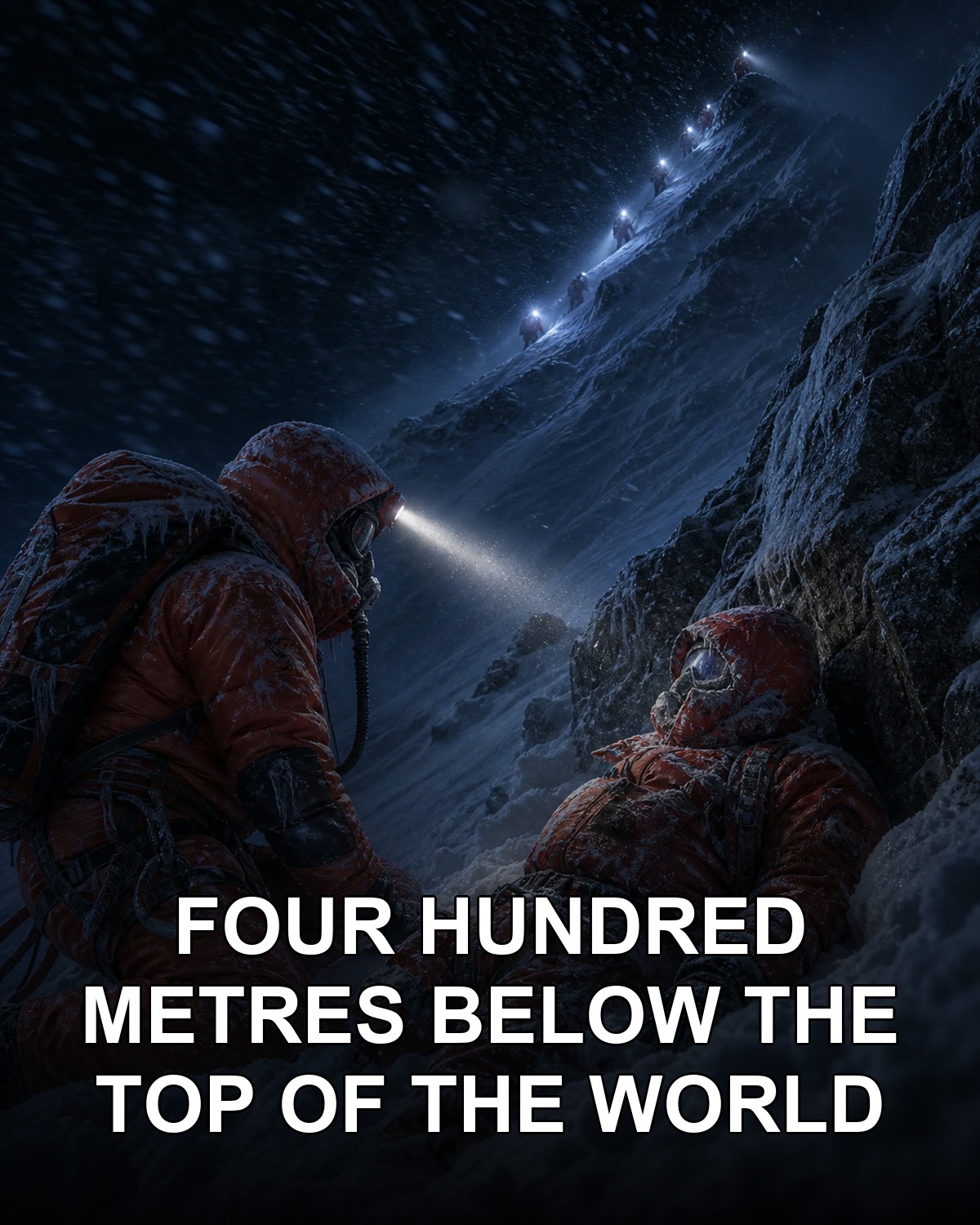
The person on the ground was a woman. Red one-piece suit, torn in several places. Her carabiner was jammed in the fixed line. Her oxygen was empty. Her right hand had no glove and had gone black with frostbite. The thin glove on her left hand was no protection against anything.
She had been there about an hour, and had tried repeatedly to free herself.
The only light in that place came from the headlamp of the man who had just arrived. Outside that circle there was night, and slope, and the fixed rope running away into darkness in both directions. On the whole stretch of slope there was nobody else.
Later it would be known that she was Liu Qunying, fifty years old, an employee of a bank in Zhuzhou, Hunan — the same province as the two men now standing in front of her. That morning, at ten thirty-eight, she had reached the summit of Everest. She was on her way down when she became separated from her guide.
The first thing Fan Jiangtao noticed was not her face. He saw the brand on her clothing, and thought: probably Chinese.
His guide advised him to go on.
The advice was not callous. At that altitude, stopping for a stranger means putting yourself and the person with you in a place where you die. Lakpa said plainly that there was no saving her.
Fan Jiangtao stood up and walked on.
He got about thirty metres before he stopped.
He stood there, and turned his head to look back down at where the woman lay.
Thirty metres behind him the red suit was still in the same place. Looking up, there were the lamps of the people still climbing, strung in a line toward the summit. Not one of them had stopped.
In his head at that moment were three years of preparation, several hundred thousand yuan in equipment, close to five hundred thousand yuan in expedition fees, and the last four hundred metres lit up ahead of him.
Then he told his guide his climb ended here. Alive or dead, he was taking this person down.
The time was about quarter to nine. From seeing her to deciding: twenty-five minutes.
He went back, took off his own reserve oxygen bottle and gave it to her to breathe. He gave her one of his gloves. He gave her hot water to drink and rubbed her hands to bring them back.
The woman tried to stand.
It took her half an hour to get up.
The two men took her under the arms and felt their way down the slope one step at a time. That section is steep; a slip is a fall. At that altitude, walking with empty hands means one breath per step. They were breathing and supporting a third person at the same time.
Nobody could speak. Up there, opening your mouth costs breath. There was only the sound of breathing through masks, the scrape of crampon points on ice, and every few steps a pause standing still to recover.
In more than an hour, the three of them covered a little over a hundred metres.
At around ten at night she lost consciousness. They patted her awake. She managed to say that she could not get up again.
By that point Fan Jiangtao and his guide were close to spent as well.
They laid her down where she was and went back up the slope to find help.
They had not gone far before they met Xie Ruxiang and his guide coming up.
He heard them out and agreed at once.
But four people was still too few. To get the two Sherpas to take on the job — a job outside their contracts, and one that could cost them their lives — Xie Ruxiang made a promise: get this person down to Camp 4 and he would pay ten thousand US dollars.
He told the woman on the ground that with him there, she would not die.
The four of them went back to her.
Xie Ruxiang went ahead to break trail. Fan Jiangtao and the two Sherpas took turns carrying her. With her gear she weighed around eighty kilograms. Fan Jiangtao would later say that stretch was harder than running a hundred kilometres — hard enough that breathing itself hurt.
There is a detail here that few people notice. Both men had already given away their reserve oxygen. They made the whole descent with no oxygen held back for themselves.
At about a quarter past midnight on 19 May, the five of them reached Camp 4.
Thirty minutes later her vital signs stabilised.
At half past seven in the morning, staff from the expedition company came up to collect her.
Counting from the moment Fan Jiangtao saw her on the ground, eleven hours had passed.
Then it was daylight.
Like everyone who climbs Everest, Fan Jiangtao had carried a large bag. In it were flags: his own, his company's, his sponsors', his school's, the flags of organisations that had backed him. He had meant to raise them on the summit.
He took them out at Camp 4 and photographed them one by one.
The background was the snow in front of the tent and a few other tents the same colour. The summit was behind him, nearly four hundred metres higher than where he stood, and it was in the frame.
Asked later how he felt at that moment, he did not talk about the rescue. He said there was only one thing in his head: that he had not reached the top.
The two men rested at Camp 4 for several days before going down.
What they had finished doing that night — bringing a person who could not walk down from 8,450 metres, with no specialist equipment, four people — was something the climbing world had until then regarded as impossible.
The story should have ended there.
It did not end there.
On 3 June, Fan Jiangtao said the ten thousand dollars promised to the two Sherpas had been paid — out of his and Xie Ruxiang's own pockets, five thousand each.
According to Chinese press reporting at the time, of that ten thousand dollars, the rescued woman covered four thousand.
The figure of four thousand out of ten thousand spread across Chinese social media and grew into one of the largest controversies of the year. The topic drew hundreds of millions of views on Weibo.
Then it slid out of control. The woman's workplace was traced. Personal photographs of her were dug up and circulated. People called her every name available.
What is notable is that the two men cast as the wronged parties in that story were the two who spoke up to stop it.
In early June, first Xie Ruxiang and then Fan Jiangtao posted publicly, asking that the matter be closed and dropped. They said that nobody had sat there calculating money at the time of the rescue. They had saved her, and they hoped she would live well. They asked people to stop hunting her, stop attacking her, stop abusing her.
On 10 June the expedition company — a mountaineering business based in Xinjiang — issued a statement. It set out why she had become stuck: after summiting at ten thirty-eight on the morning of 18 May, she and her guide had become separated on the descent because of a breakdown in communication; her carabiner then jammed in the fixed line at around 8,450 metres and she could not free herself.
The company accepted this as its own fault, apologised, and announced it would cover all costs arising from the rescue.
As for the rescued woman, she said she remembered almost nothing of the rescue itself — she had been unconscious at the time. She declined to speak to the press. It was later reported that she had sought the two men out to thank them.
On 23 May 2023 the Hunan Provincial Sports Federation issued a statement confirming the leading role of Fan Jiangtao and Xie Ruxiang in the rescue.
A string of honours followed. In July 2023 both received the national award for collective acts of bravery in defence of others — the Chinese state's recognition for those who risk themselves to save a life.
At home, though, the first reaction to Fan Jiangtao was not praise.
His parents were living in another city at the time. Hearing the news, they flew to where he was. By his own account in an interview, over two days there they did exactly one thing: they scolded him. For recklessness. For not valuing his own life.
Driving them to the airport, he could not hold it any longer. He told his mother that she had come for two days and scolded him for two days, and had not once asked him what he had been thinking.
He said his mother cried so much she nearly could not board the plane.
The car stopped at the drop-off, the doors opened, the flight announcements carried out from inside the terminal. The three of them stood there a while longer before they moved.
Two years on, he still describes that period with one phrase: seven hundred days of torment. He had nightmares for two years. He left the climbing organisation he had built himself.
Because within the climbing world, not everyone was on his side. Some argued that what the two men did ran counter to the spirit of mountaineering, and that it implicitly placed a moral burden on everyone else who kept climbing.
That is an argument that has not been settled.
At seventeen minutes past nine on the morning of 24 May 2025, Fan Jiangtao stood on the summit of Everest, at 8,848.86 metres.
This time he did not take the old route. He climbed the north side, from Chinese territory — harder than the commercial route on the south. To prepare, he ran eighteen trail races, with a cumulative ascent of about twenty-one thousand metres — the equivalent of climbing Everest twice before actually climbing Everest.
That morning the summit was clear. Standing there, there is nothing higher left to look up at, only cloud lying below and other peaks pushing up out of it.
The four hundred unfinished metres of 2023 had taken him two years to complete.
Xie Ruxiang was not with him. He had other commitments.
In an interview, a presenter asked Fan Jiangtao whether he would do it again if he met the same situation.
He said he would certainly still save the person.
Then he added something very level-headed, and perhaps the most honest line in the whole story: this time he had hired two Sherpas. So that if it happened again, he could leave one with the casualty and still have one to take him to the summit.
He had paid the price once, and he had planned ahead for the next time.
WHY RESCUE AT EIGHT THOUSAND METRES IS ALMOST IMPOSSIBLE
The line "above eight thousand metres there is no rescue" sounds like a cold excuse. It is in fact a technical description.
First, the air up there cannot sustain a person. From 8,000 metres to the summit, atmospheric pressure is only about one third of that at sea level, meaning each breath delivers less than a third of the normal amount of oxygen to the lungs. The body no longer recovers. It only degrades. This zone is called the death zone in the literal sense: every hour spent there is a subtraction from a life account, and there is no way to repay it except by going down.
Second, everyone up there carries only enough for themselves. Oxygen bottles are finite and calculated precisely against the time needed to summit and descend. Letting someone else breathe your reserve bottle means removing your own last layer of insurance.
Third, nothing can get up there. Rescue helicopters in Nepal generally reach only about 6,000 metres, at the very most the area around Camp 2. The air is too thin for the rotors to bite. Above that, the only rescue vehicle is human muscle.
Fourth, and this is the harshest part: carrying a person is an arithmetic problem in manpower. On a night slope, the carriers must hold the balance of two bodies. One slip loses the group. That is why Everest's history contains cases of dozens of people walking past a dying person without stopping — not necessarily because they were callous, but because the arithmetic did not work.
On the night of 18 May 2023, the arithmetic did not work either. There were two people, not four to six. There was no rescue equipment. It was night. It was on the slope.
They did it anyway.
A small note on the numbers. "Four hundred metres from the summit" is a vertical difference in altitude, not a distance walked. Four hundred metres of height in the death zone usually corresponds to several hours of climbing. Which is also why, when Fan Jiangtao turned around, what he gave up was not a few steps — it was the result of three years.
Sources
- https://hunan.voc.com.cn/news/202305/22848212.html
- https://news.qq.com/rain/a/20230526A05PXO00
- https://www.chinadaily.com.cn/a/202305/27/WS64719e59a310b6054fad5645.html
- https://news.bjd.com.cn/2023/06/12/10461387.shtml
- https://www.thepaper.cn/newsDetail_forward_23361024
- https://www.thepaper.cn/newsDetail_forward_23387854
- https://www.sohu.com/a/689816878_121124690
- https://m.bjnews.com.cn/detail/1749087910168503.html
- https://news.qq.com/rain/a/20250605A02AET00
- https://www.scmp.com/news/people-culture/trending-china/article/3222402/
- https://explorersweb.com/everest-chinese-woman-refuses-pay-rescue/
AI-generated illustration. Not a photograph of the actual incident.