They found an air pocket, and photographed it
Three men over fifty went into a Catalan sea cave with one cylinder each and no guideline. Two of them found a dome of air, and thought they were saved.
None of the three men was carrying a guideline reel.
Each carried a single cylinder and nothing more. All three were over fifty; the oldest was past sixty. Between them they had more than seven hundred hours of diving.
At about ten in the morning on Saturday 19 July 2014, they dropped into the Mediterranean roughly a nautical mile north of the harbour at L'Estartit.
Cova dels Arquets lies beneath the headland of the same name. The entrance opens at a depth of about seven or eight metres and is roughly two and a half metres wide.
It is a beautiful cave. Stalactites hang from the ceiling, stalagmites rise from the floor. Lobsters shelter there in such numbers that local divers have a second name for the place: the lobster cave.
The whole cave is about eighty metres long. That number sounds very short.
But eighty metres inside a flooded cave is not eighty metres on land. There is no line of retreat except the one you swam in along. You cannot go up. Above your head is rock.
Past the entrance the passage slopes upward for about four metres, then opens into the main chamber. Divers call it the clay room.
The floor of that chamber is covered in a fine white silt. It had lain there, flat, for thousands of years with nothing to disturb it.
All it takes is one slightly heavy kick.
A fourth man stayed on the boat as surface cover.
The three in the water followed the planned route. The first stretch went perfectly — lobsters, formations, beams sweeping the walls. Very quickly they reached the entrance to the clay room.
They had barely got inside when the white silt on the floor lifted.
Silt in a flooded cave does not settle like silt in the open sea. It hangs and expands. A torch shone into it makes only a milk-white halo, and the harder you shine, the more it dazzles and the less you see.
Visibility fell fast.
One of the three became frightened. He signalled with his hand: I want to go out. He turned and swam back toward the entrance.
The other two decided to continue.
That decision would later save one life and end another — but not in the way you would expect. The man who turned back was the one who came out unharmed. He was also the man who, a day later, would have to crawl back into that cave.
The two who stayed swam around the clay room a while longer, then also decided to head back the way they had come.
Only when they turned did they see what had happened behind them.
Every fin kick had stirred up more silt. The whole chamber was now thick water. Visibility was under half a metre.
They could not see the exit.
Their gauges read about a third of a cylinder.
And they had no line.
In cave diving, the line is not a safety accessory. It is the entire navigation system: when the water goes out, you do not need to see, you just hold the line and follow it out.
Without a line, the eyes are the only thing left. And the eyes had just been taken away.
What surrounded them now was not darkness but a dense white with no depth to it, no up and no down. There was only their own breathing hissing through the regulators, faster with each cycle.
The two men began to panic.
Then their hands found a crack in the wall. They went into it the way a drowning man goes for a post.
The crack was tight. They had to squeeze through sideways. The rock tore both their suits.
Five minutes later, all at once, the weight came off them. They had come out the other side.
In front of them was an underground lake.
The water on this side was clear. The beams carried, sweeping across an expanse with no visible far shore, touching rock that no light had ever reached. Behind them the crack had closed into a dark seam in the wall.
Nobody had ever been in here. Nobody had ever drawn this place on a map.
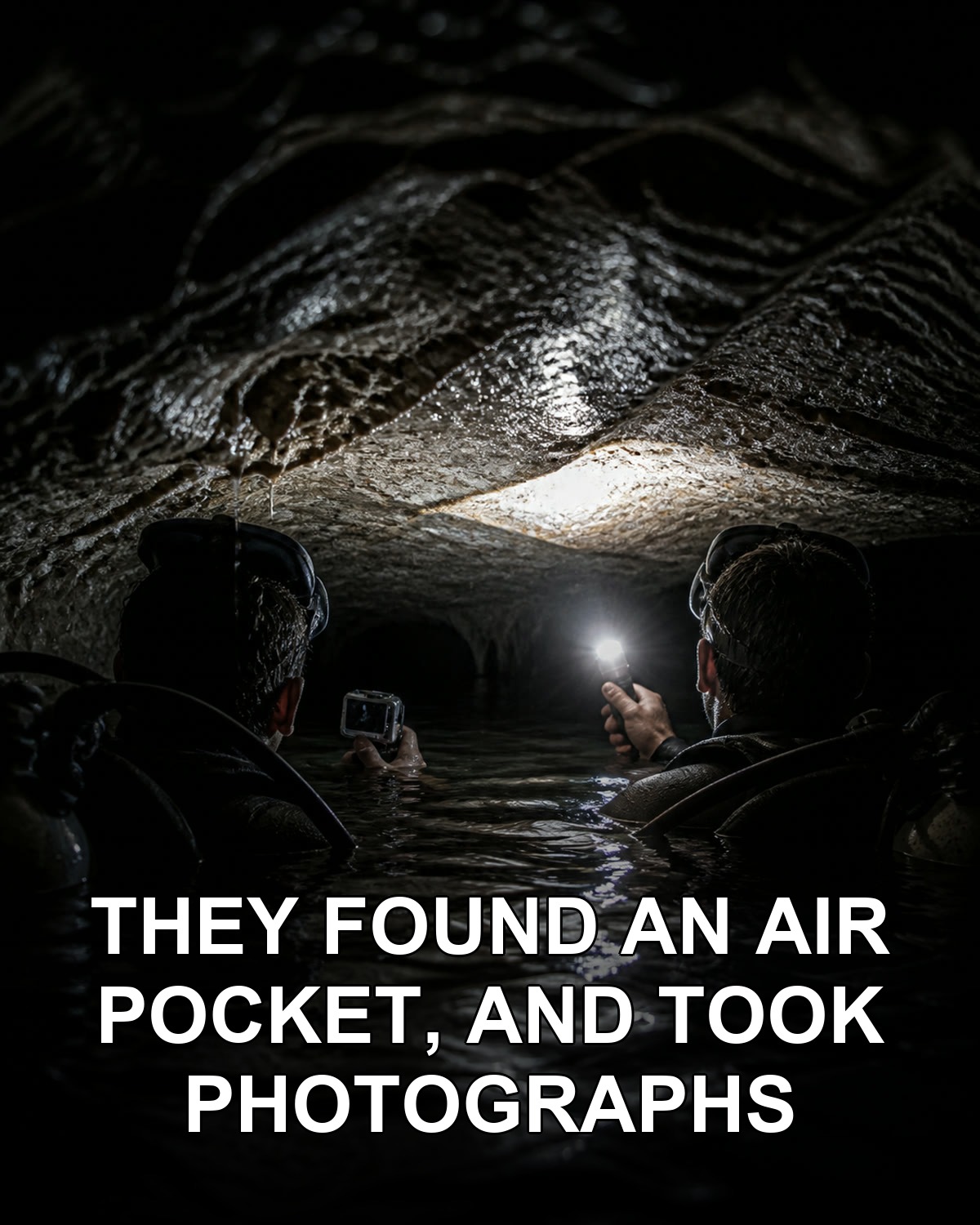
The two swam about looking for a way out, like flies with their heads off. Then they looked up and saw something strange: the water above them was gone. The ceiling arched up above the surface. There was an air pocket there.
They surfaced. They took the regulators out of their mouths.
And they could breathe.
After all those minutes fighting in the dark, two men in their fifties and sixties embraced each other inside a cave nobody knew about, at the bottom of the Mediterranean.
Then one of them took out a camera.
They took a few photographs to remember it by.
Neither man knew that the place which had just saved their lives was the thing that was about to kill one of them.
The pocket looked generous. Perhaps three or four square metres of water surface, the ceiling vaulted over it like a round roof.
But it was a sealed space. No wind. No opening to the sky. The quantity of air inside it was a fixed number, shut in there a very long time ago.
With every breath out, the two men gave a little carbon dioxide back into that dome. With every breath in, they took a little oxygen out of it.
The dome was not a shelter. It was a countdown clock, and the two men had just started it with their own breathing.
On the surface, the man who had turned back reached the boat. He and the surface cover raised the alarm at once.
Early that Saturday afternoon, GEAS — the underwater specialist unit of the Spanish Guardia Civil, Girona detachment — got the call.
They were in the water almost immediately.
On the surface it was July: hard sun, blue water, the sand bottom visible in ripples. The cave mouth opened at seven or eight metres, a narrow dark gap in the rock. A few body-lengths past it, the light stops.
And they could not get in.
The silt the two men had raised was still hanging in the cave. A torch shone into that water reached about twenty centimetres. The head of the GEAS team, Fernando Aguirre, later described the working conditions that day in one word: terrible. His men were working blind.
The first search lasted about an hour before it had to be called off.
As the afternoon went on, more people arrived. Local residents came out to help — fishermen from around the area, and a biologist who had done research there. The biologist handed the rescue team a map of the cave.
They opened it. The map ran as far as the clay room and stopped.
Past the clay room, blank paper.
Because before that day nobody had ever gone through that crack. Nobody knew there was a lake. Nobody knew there was an air pocket.
The rescue team was standing in front of a cave whose best available map ended precisely where the two missing men were.
Inside the stone dome, time was passing differently.
A note is needed here. The Catalan press at the time did not release the two men's names. They were identified only by age and place of residence — sixty-two, from Gavà; fifty-three, from Barcelona. First names for the two do circulate in later retellings of the accident online, but no news source ever confirmed them, and no surnames of any kind are documented. This account therefore refers to them as the older man and his companion.
At around one in the afternoon, the older man — sixty-two, from Gavà — began to suffer a violent headache. His fingers twitched continuously. His speech slurred and lost its shape.
His companion, fifty-three, from Barcelona, thought he was dehydrated and gave him some of the fresh water they had.
It made no difference.
Those symptoms were not dehydration. They were the early signs of hypercapnia — carbon dioxide build-up, which arrives before the oxygen has time to run out.
The water in the cave holds seventeen degrees all year round. The two had been immersed in it since morning, and that cold does not sting once and stop; it draws heat away steadily, with no way to push back. Above them the wet vault threw back their lamplight as a small yellow halo. Outside that halo there was nothing to look at.
At three in the afternoon, the older man began to lose consciousness. Then he slid into the water and started to sink.
His companion dived after him and pulled him back up.
The older man was still lucid. He told his friend he did not want to die.
His friend told him to hold on. Rescue would come.
For the two hours that followed, the fifty-three-year-old held one position: one arm around his friend, one hand gripping a knob of rock on the wall, trying to keep both their heads above the surface.
At five in the afternoon, the older man lost consciousness completely and sank a second time.
His companion dived down and brought him up again.
Later, when the data was pulled from both men's dive computers, those two descents were still there in the memory. Nobody had to take anyone's word for it. The machine had recorded them.
This time he was no longer breathing. Ten minutes later his heart stopped.
His companion was spent. He could not hold on any longer.
He let go.
And he watched his friend sink slowly to the bottom of the lake, in the dark, in a place that had no name on any map.
Then he was there alone.
No light reaching him. No sound but water. Nothing to do. He held on to the rock, kept his face close to the vault, and breathed air that was getting worse. The dome was low enough that his forehead touched wet stone. The air was saturated with moisture, warm and clammy, each breath a little heavier than the one before. Now and then a drop fell from the ceiling, and that sound was the only proof that time was still moving.
He stayed in that position through the night.
At seven on Sunday morning, visibility in the clay room had recovered to about five metres.
The second search began.
All the way in, the rescue team found no trace of either man. Which meant the two were not in the known part of the cave. They were in the blank paper.
The team decided to push through the clay room and continue into ground nobody had ever entered. They found the crack. They squeezed through.
On the other side was the lake.
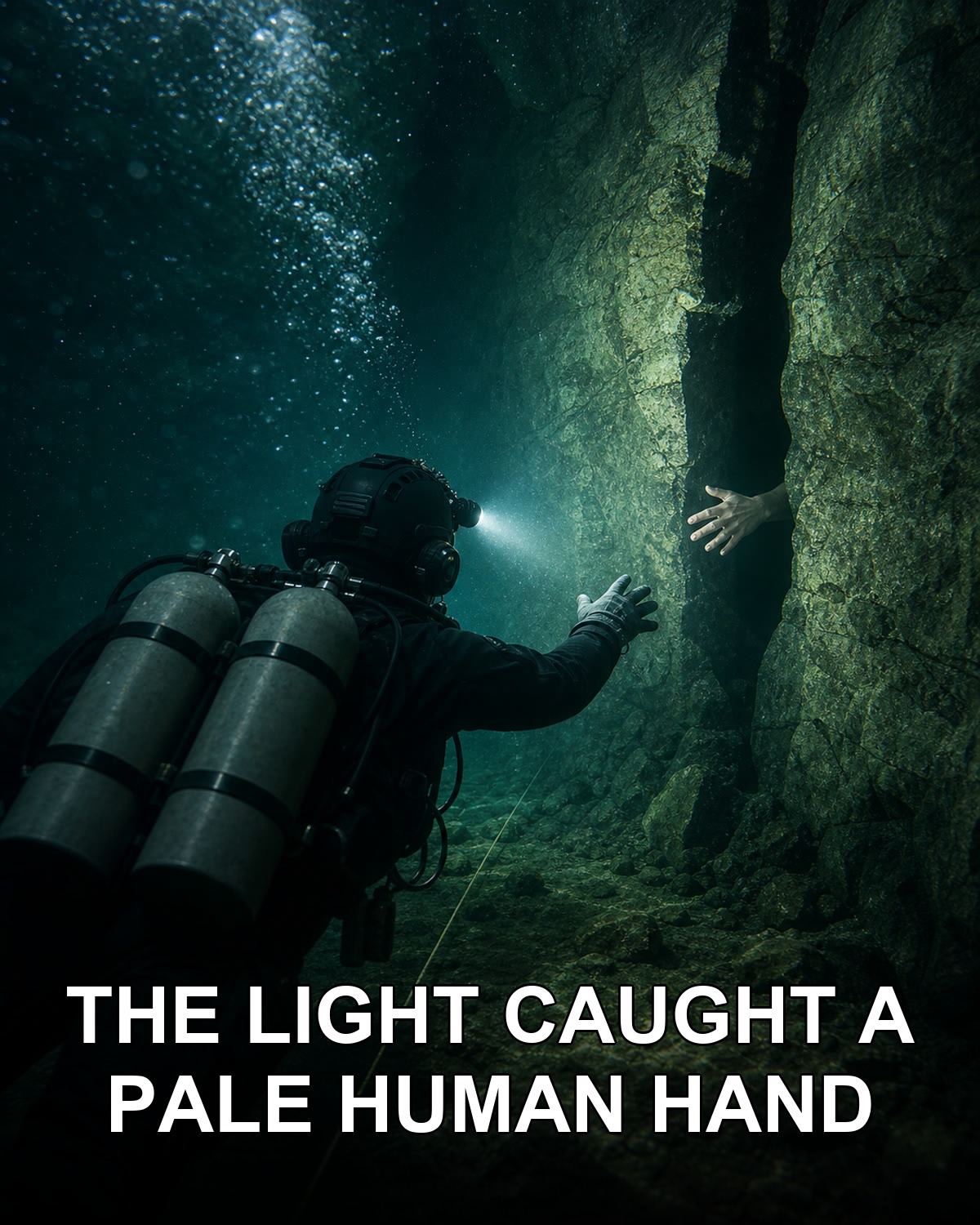
And they saw the older man immediately, lying on the bottom.
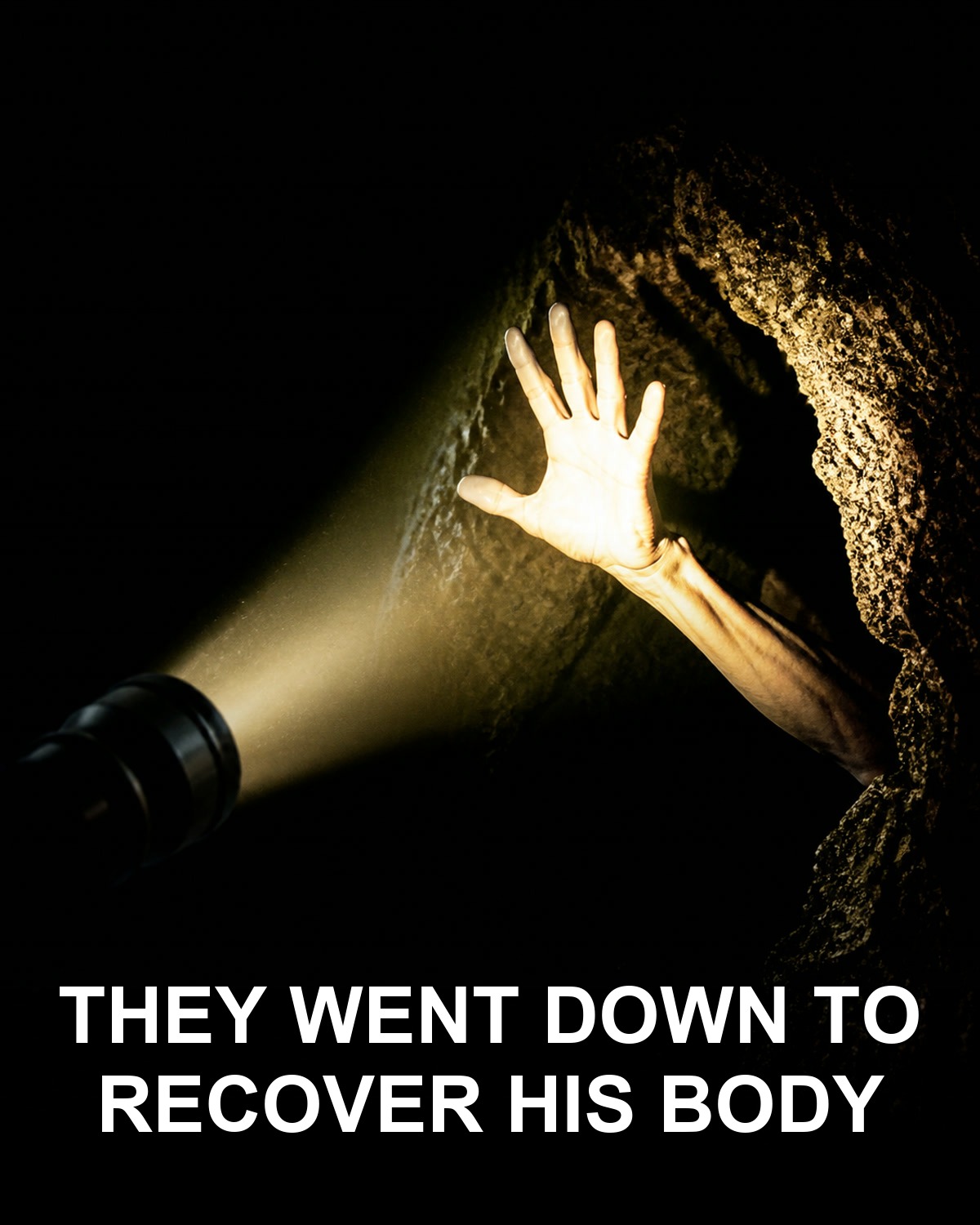
Then they found his companion, clinging to the rock wall, barely conscious, showing clear signs of severe dehydration and hypothermia.
A rescuer offered him an oxygen mask.
He pushed it away.
He looked at men in black suits and masks carrying lights, swimming toward him out of the darkness — and he did not understand who they were. By then his mind had begun to hallucinate.
He believed they were death, come to collect him.
The rescue team had to do something no procedure covers: they went back out and brought his friend — the same man who had turned back the day before — all the way into the bottom of the cave.
The survivor saw his friend's face.
And he burst into tears.
That was the moment he believed the others were not death.
He was still not stable. There was a fear that he would struggle mid-passage and take the whole group down with him, so he was given a sedative.
At half past nine in the morning, two divers, one ahead and one behind, brought him through the crack.
Then they followed the guideline the rescue team had laid — the thing the two men had not brought with them the day before — and took him out.
Early on Sunday afternoon, he broke the surface.
He had been down there about twenty-seven hours.
A helicopter took him to the Trueta hospital in Girona. He lived.
Getting one man out of that eighty-metre cave cost GEAS twelve dives in total.
Recovering the older man's body had to be postponed because of bad weather. Not until midday on Monday 21 July was he brought up.
Where he lay was forty-seven metres deeper than the place where his friend had clung to the wall.
The autopsy later established that the older man had not drowned.
He died of hypercapnia. The carbon dioxide level in his blood was three times normal.
Which is to say: the stone dome killed him, not the water.
Fernando Aguirre, who commanded the rescue, said one short thing about the survivor: he did everything he could. Put anyone else in his place and they would not have done better.
There is one more thing worth adding, and it is the real end of the story: this rescue eventually went to court.
Two of the GEAS divers on the operation were put forward for a decoration. The Spanish Interior Ministry rejected the application. The case went to the High Court of Justice of Catalonia. The court reviewed the file: inside the cave, these two men had cleared rock blocking the passage, carried cylinders and electrolyte fluid in to the casualty, relieved the pair of rescuers who had gone in ahead of them, separated from their own buddy — an absolute prohibition in the trade — and gone past the two thirds safety threshold at which every diver is required to turn around.
The court ordered the Interior Ministry to award the decoration.
The survivor was the first diver in Spain to come out of an accident of this kind alive.
WHY IT HAPPENED
1. Why stirring the silt means total loss of orientation
The sediment on the floor of a flooded cave is ultra-fine, settled over thousands of years in an environment with no current. Disturbed, it does not drop back like sand — it hangs and diffuses through the whole chamber. A light shone into it only scatters off the suspended particles straight back into the diver's eyes, exactly like putting a car's high beams on in fog: the more power, the more glare.
A flooded cave also has no surface to rise to for orientation and no clear gravity cue for which way is up. When visibility goes to zero, a diver loses the concept of direction altogether. This is why the first principle of cave diving is the guideline — not as a precaution, but as a replacement for eyes that are certain to fail.
The three men at Cova dels Arquets had more than seven hundred hours of diving between them, but open-water diving and cave diving are two different trades. None of the three held a cave diving certification. And none of them carried line.
2. Why an air pocket in a flooded cave is a trap, not a shelter
This is the most counter-intuitive part, and it is the part that killed the older man.
Two people breathing inside a sealed dome of three or four square metres do three things at once:
· They draw the oxygen down. Below roughly 10 per cent, life is threatened.
· They drive the carbon dioxide up. This is what arrives first.
· They saturate the air with water vapour, which makes the body lose heat faster.
CO2 is the earlier killer. The body tolerates a shortage of oxygen longer than it tolerates an excess of carbon dioxide. As CO2 accumulates, the victim suffers a violent headache, muscle twitching, slurred speech, confusion, then coma — precisely the sequence the older man went through between one and five in the afternoon. His blood carried three times the normal concentration.
Add seventeen-degree water for more than a day and a night: hypothermia and dehydration. The survivor came out of the cave with both, plus hallucinations — confused enough to see the rescue team as death.
Put another way: the air pocket did not save the two men. It changed how they would die, and bought them time. For one of them, the time it bought was enough for rescuers to arrive. For the other it was not.
3. A note on "the unmapped part of the cave"
A number of online accounts of this incident reproduce a map of the cave alongside the narrative. It should be said clearly: the detailed survey of Cova dels Arquets was made long after the accident. Two divers, Fabio Rueda and Joel Llebot, surveyed and published the data on this cave in December 2021.
Which means that in 2014, when the GEAS team went in looking for two men, they really were swimming into blank paper. The only map they had in their hands ended at the clay room.
4. A correction
Some accounts say that when the rescuers arrived, the older man's body was floating beside his friend. That detail is hard to sustain. His cylinder had been empty for some time, so his buoyancy device could not have inflated itself; the cave water is only seventeen degrees and the body was found within less than a day, far too soon and far too cold for buoyancy from decomposition. The contemporaneous Catalan news reports all place him forty-seven metres deeper than the survivor, in the underground lake.
Sources
- https://www.ara.cat/societat/guardia-civil-recupera-submarinista-lestartit_1_1620497.html
- https://www.ara.cat/societat/submarinista-critic-quedar-atrapats-lestartit_1_2060753.html
- https://www.gerio.cat/noticia/188699/recuperen-el-cos-del-submarinista-mort-en-una-cova-de-lestartit
- https://naciodigital.cat/societat/recuperen-el-cos-del-submarinista-mort-en-una-cova-de-lestartit.html
- https://www.3cat.cat/3catinfo/mor-un-submarinista-i-un-altre-esta-en-estat-menys-greu-en-quedar-atrapats-en-una-cova-a-prop-de-lestartit/noticia/2452833/
- https://www.radiocapital.cat/condecorats-guardia-civil-rescat-arquets-estartit/
- https://espeleoworld.com/en/c/cova-dels-arquets
- https://scubaboard.com/community/threads/one-dead-one-critical-after-20-hours-in-cave-spain.487968/
AI-generated illustration. Not a photograph of the actual incident.