The PTA President Called Me "Just the Woman Who Scoops" in Front of 200 Parents — So I Asked the School Board One Question
"She's not staff, she's a server. She scoops. Let's not pretend the woman who scoops the green beans is a policy expert."
"Ma'am, please address the board and not the audience."
"I am addressing the board. I'm addressing the board about her."
"Then address the board about her."
"Fine. I'd like the board to know that the person you have running that kitchen has been openly defying a directive that this parent organization voted on, unanimously, in April."
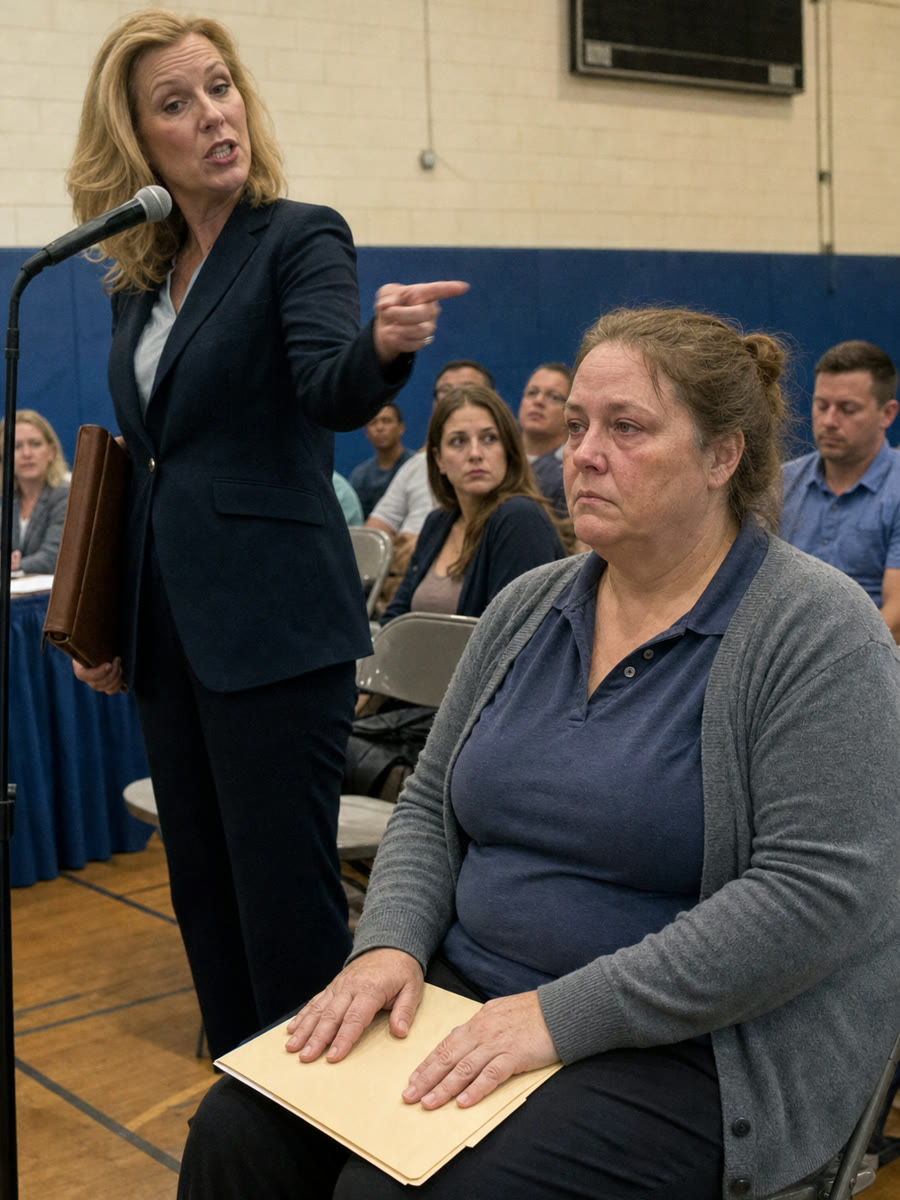
I was in the fourth row on the aisle, in the chair with the wobble, holding a manila folder on my knees.
I'd been there since 6:40 because the agenda said item nine and I've learned that item nine can happen at 7:15 or it can happen at 9:40 and nobody will ever tell you which.
"Mrs. Vandermeer, you have three minutes remaining."
"I'll need less than that."
She had a folder too. Hers was leather.
"My name is Priscilla Vandermeer, I'm the president of the parent-teacher association at Hollis Creek Elementary, and I'm here about the negative balance situation."
"Go ahead."
"As of the first of this month the outstanding meal debt at that one building is nine thousand four hundred and twelve dollars."
"That figure's in the packet."
"I know it's in the packet. I'm saying it out loud because a number in a packet is a number nobody reads."
"Understood."
"In April our association voted on a very reasonable, very common intervention. Students carrying a negative balance receive an alternate meal. A cheese sandwich, a milk, a piece of fruit. Not nothing. Nobody's going hungry. A sandwich."
"And?"
"And it doesn't happen. It has never once happened. Because the woman who runs that kitchen decided, personally, that she wasn't going to do it."
Somebody two rows behind me shifted in their chair.
"The point of an alternate meal isn't the sandwich," she said. "Let's all be adults. The point is that a parent gets a phone call from their child that evening. That's the mechanism. That is the entire mechanism."
"Mrs. Vandermeer—"
"I'm not embarrassed to say it. The parent has to feel it. Otherwise the number in the packet is nine thousand this year and eighteen thousand next year and then it's a line item and then it's your problem, not theirs."
"Is there a question for the board?"
"My question is why a forty-thousand-dollar-a-year employee gets to override a directive from the parents who fund half the equipment in that building."
Then she turned around. Away from the microphone, toward the room, which is the thing they tell you not to do.
"She's right there, by the way. Fourth row."
Two hundred people turned around.
I want to be accurate about the number. The gym holds three hundred and twelve when they set out every chair, and they'd set out every chair, and there were people standing at the back by the trophy case. So two hundred is me being careful.
"Ma'am, the microphone."
"I'm going back to the microphone."
She went back to the microphone.
"Twenty-two years is a long time to do a job. I understand that. But twenty-two years of scooping does not make somebody a nutritionist, and it certainly doesn't make somebody a lawyer, and I'd like the board to be very clear about what she actually is."
"Are you concluding?"
"I'm concluding. What she is, is a person we pay to put food on a tray. That's not an insult. That's a job description."
"Thank you. Your time's expired."
She sat down in the second row, in the middle, where she always sits.
I didn't say anything. Not because I'm brave. Because item nine hadn't been called yet and if you speak out of turn at a board meeting they take your card.
*
"You okay?"
That was Wanda, next to me. She does the line at the middle school and she'd come to sit with me because I'd asked her to.
"I'm fine."
"You're not fine."
"I'm sitting."
"You've got white knuckles on a folder."
"It's my folder."
"Deb. Look at me."
"I'm looking at the agenda."
"They're on item six."
"I know what they're on."
"That's forty minutes of bus routes."
"It's thirty-five. They always do bus routes in thirty-five."
She sat back.
"Twenty-two years," she said.
"Yeah."
"She said it like it was a sentence you served."
"I know."
"Are you going to say anything?"
"When they call the item."
"That's not what I asked."
"It's the answer I've got."
*
Let me tell you what my morning is, because it matters later.
I get to Hollis Creek at 5:05. Not five, 5:05, because the alarm code resets at five and if you punch it before the reset you get a call from a man in another state asking you to say a word.
The delivery comes Tuesday and Friday between 5:30 and 6:15. Produce Wednesday. Milk daily, and milk is the one that will kill you, because milk has to go from the truck to the cooler and the cooler has to log between thirty-three and forty-one degrees, and if the truck is late and the crates sit on the dock in September you are throwing out three hundred and forty half-pints and calling the district.
Steam tables go on at 6:40. They have to hold at a hundred and thirty-five or above. I temp them at 6:55, at 10:15, and again at the start of every service, and I write the numbers on a sheet on a clipboard that hangs on a nail by the walk-in.
Four hundred and six kids eat lunch at that building. Three services: kindergarten and first at 10:55, second and third at 11:35, fourth and fifth at 12:15.
I have two people. Rosalind, who's been with me nine years, and Kimmy, who's been with me since February.
That's the whole operation. Three women, four hundred and six children, six hours.
Everything in that room is a temperature or a count. The kids are a count too, and that's the one that pays for all of it, and it's only worth anything if it's true.
Twenty-two years and your hands know things before you do. I can hear a clogged jet in the dish machine. I can look at a hotel pan across a room and know it'll run out at the back half of second service, and start the backup before anybody notices there was almost a problem. Nobody writes that down anywhere.
What does get written down is the claim.
*
"Deb, they're on eight."
"Okay."
"You want water?"
"No."
"Deb."
"I don't want water, Wanda."
"You're going to talk for three minutes with a dry mouth."
"Fine."
She handed me a bottle out of her bag and I held it and didn't open it.
*
The thing about item nine is I'd put it there myself, in June, in writing, on the form, which is a thing almost nobody knows you can do.
"Requested by: D. Amsler, Cafeteria Manager, Hollis Creek Elementary."
"Topic: Meal charge policy — request for board clarification and written direction."
I'd typed it on the computer in the office by the freezer that takes ninety seconds to wake up.
I'd asked for one thing. I'd asked the board to tell me in writing who my instructions come from.
That's the whole request. One sentence.
*
"Item nine. Request for clarification of meal charge policy. Ms. Amsler, are you here?"
"Yes, sir."
"Come on up."
I went up. The podium's the kind with a light on a gooseneck and the light was pointed at my chest.
"You've got three minutes."
"I don't think I'll need three."
"Take what you need up to three."
"Thank you."
I opened the folder.
"My name is Deborah Amsler. I'm the cafeteria manager at Hollis Creek Elementary. I've worked in this district's kitchens for twenty-two years, nineteen of them at that building."
"Go ahead."
"In April I got an instruction. It didn't come to me from the district, it came to me in a phone call, and then in an email, and then in a second email. The instruction was to stop serving hot lunch to students carrying a negative account balance and serve them a cheese sandwich instead."
"From whom?"
"From the parent-teacher association president."
"Continue."
"I didn't do it. I want to be clear that I didn't do it, and that I never hid that I didn't do it. I answered both emails and said no in writing."
"Why?"
"That's what I'm here to ask about. I'd like the board to give me a written statement of who my instructions come from."
"That's your request?"
"Yes, sir."
"Ms. Amsler, is there some confusion about that?"
"There's no confusion on my end. There's confusion in my building."
"Meaning?"
"Meaning I've had a person come into my kitchen during a service and tell my staff to do something, and my staff is twenty-two and thirty-one years old and they don't know who they're allowed to say no to."
"Somebody came into the kitchen."
"Behind the serving line. During second service."
"Who?"
I didn't say it.
"It's in my folder if the board wants it. I'd rather answer the question I came to ask."
Somebody in the second row said something to somebody next to her.
"Ms. Amsler, you're asking us to tell you who you report to. You report to your building principal and to the district's food service director."
"Yes, sir."
"Is that not clear?"
"It's clear to me. I'm asking for it in writing."
"Why writing?"
"Because I sign something every month, and I'd like the record to show who was telling me what."
"You sign something."
"Yes, sir."
"What do you sign?"
And that's when I looked at the clock on the gym wall, which said 8:19, and thought: not yet.
"I'll come back to that if the board wants me to."
"We'll come back to it."
"Thank you."
I sat down.
"Deb," Wanda said.
"I know."
"You had it right there."
"I know."
"Why didn't you—"
"Because she hasn't said it yet."
*
The first email was April 3rd. I printed it that day. I print everything.
"Deborah — following up on our call. The PTA executive board voted 7-0 Tuesday night to implement the alternate meal for negative balances effective Monday. Cheese sandwich, milk, fruit. I'd like this in place before spring conferences so parents feel it before they're sitting across from a teacher. Please confirm. — Priscilla"
I wrote back the same afternoon.
"Mrs. Vandermeer — I can't do that. The meal charge policy is the district's and I have to follow the one in writing. I'd be glad to sit down with you and the food service director about the balance problem, which is real. — Deb Amsler"
Then April 9th.
"Deborah — I don't think you understood me. This isn't a suggestion from a bake sale committee. Our organization put eleven thousand dollars into that building last year including the two convection units in your kitchen. I'm not asking. — P.V."
I wrote back.
"Mrs. Vandermeer — I understand you. My answer's the same and it's not about you. Please put anything further through the district office. — Deb Amsler"
She didn't put anything further through the district office.
She came to the building.
I've thought about why that email made me tired instead of angry, and I think it's the convection units. She wasn't wrong about them. Eleven thousand dollars of raffle tickets and wrapping paper, and they replaced an oven so old I had to hit the door on the side to close it. I can do two hundred rolls in one pass now instead of three. That's forty minutes back in a day that doesn't have forty minutes in it.
So she'd bought me something real, and she'd worked out somewhere along the way that it bought her a lane in my kitchen. It isn't a crazy thing to think. It's how almost everything in a small district works. Somebody pays for the thing and then somebody has opinions about the thing, and mostly nobody minds, because mostly the opinions are about the color of the field house.
A serving line is not a field house. There's a piece of paper at the end of it with my name on it.
*
May 14th, second service, 11:41.
"Deborah, a word."
"I'm on the line."
"It'll take a second."
"Mrs. Vandermeer, I have a hundred and forty kids coming through in twenty minutes."
"Then it'll take less than a second."
I had a spoodle in my hand and a hotel pan of chicken and rice at a hundred and forty-one degrees and a line of second graders in front of me.
"Can I finish this service?"
"I'd like to see how you're handling the flagged accounts."
"They're not flagged."
"Excuse me?"
"There's no flag. There's a balance in the system and I see it and that's it."
"You see it."
"I see it on my screen."
"So you know."
"Ma'am, I've got kids at the line."
"Show me one."
"No."
"Show me one, Deborah."
"No, ma'am."
"Why not?"
"Because there's a child standing right there."
She looked. There was. He was seven and he was holding his tray with both hands the way they do at that age, up under the chin, and he was looking at both of us.
"Go ahead, sweetheart," I said. "You want the roll?"
"Yes."
"Take two, you're tall today."
He took two and went.
"That's cute," she said.
"It's a roll."
"That's not what I mean and you know it."
"Rosalind, take my spot."
"You got it."
I walked her out past the milk cooler to the doors and stood so my back was to the cafeteria.
"You can't be behind the line."
"I'm a volunteer in this building."
"Not behind the line. Nobody's behind the line without a food handler card and a hairnet, that's not me being difficult, that's the health department."
"Fine. Then out here. Explain to me why you won't do it."
"I've explained it twice in writing."
"You've refused twice in writing. That's different from explaining."
"Okay. Then I'll explain it out here. If I hand a kid a cheese sandwich instead of the meal that's on the menu, that's not the same meal."
"Obviously it's not the same meal. That's the point."
"That's my point too."
"Meaning what?"
"Meaning it's not just softer or worse. It's a different thing entirely and it doesn't go through the register the same way."
"Deborah, I don't need the technical—"
"You asked me to explain."
"I asked you to explain in a way that's about children and not about a cash register."
"It is about children."
"It's about paperwork."
"Mrs. Vandermeer, in my job those aren't two different things."
She looked at me for a second the way people look at a sign in a language they don't read.
"You know what I think?"
"No."
"I think you've been in that kitchen a very long time and you've gotten comfortable, and comfortable people say no to things because no is less work than yes."
"Okay."
"That's it? Okay?"
"I've got a hundred and forty kids."
*
"What did she want?" Rosalind said, after.
"The thing from April."
"The sandwich thing."
"The sandwich thing."
"Are we doing it?"
"No."
"Deb."
"No, Ros."
"I'm just asking because Kimmy asked me and I didn't know what to tell her."
"Tell her no."
"She's scared of that lady."
"Everybody's scared of that lady."
"Are you?"
"I'm fifty-five years old and I make twenty-one dollars and forty cents an hour, six hours a day, a hundred and eighty days a year. She said forty thousand into a microphone. You can do that one yourself. She rounded me up by about seventeen thousand dollars and not one person in that gym blinked. What exactly is she going to do to me."
Ros wiped down the rail and didn't answer.
"That was a joke."
"It wasn't funny."
"It wasn't."
*
Kimmy came to me in June, in the walk-in, which is where everybody comes to me because it's the only place in that building where nobody can walk in behind you.
"Deb, can I ask something and you not think I'm dumb."
"Ask it."
"What happens if we did it."
"Did what?"
"The sandwich."
"You want the short answer or the long one?"
"Whichever one's true."
"Both are true. Short one first. It's a mean thing to do to a seven-year-old and I'm not doing it."
"Okay. What's the long one."
"The long one's about the count."
"The count."
"Every kid who comes through that line, I hit a key. That key says: that was a lunch."
"Right."
"That's not me keeping score for fun, Kimmy. That number's the whole thing. It goes on a form, the form goes to the state, the state sends it up, and money comes back to this district based on that number."
"How much?"
"Depends on the category. Call it a few dollars a meal, four hundred and six kids, a hundred and eighty days."
She did the thing where you count on your fingers and then stop.
"That's a lot of money."
"That's the food service budget. That's my job, and Ros's job, and yours."
"Okay."
"Now here's the part. The key only means what it says if the tray was the real thing."
"The real thing."
"Five components. Grains, meat or a meat alternate, fruit, vegetable, milk. The kid has to be offered all of it and has to take enough of it. That's a lunch. That's what the word means on that form."
"And a cheese sandwich and a milk and an apple—"
"Is a cheese sandwich and a milk and an apple."
"So you'd hit the key on it anyway."
"That's the question, isn't it."
"What happens if you do?"
"Then I've written down that I served a lunch on a day I served a sandwich."
"To like, six kids."
"Say six a day. Say a hundred and eighty days."
"Oh."
"Yeah."
"And who—" She stopped. "Who gets in trouble for that?"
"That's the long answer, Kimmy."
"You didn't say it."
"No, I didn't."
*
"They're coming back to you," Wanda said.
"On what?"
"On the thing you didn't answer."
"Okay."
"Deb, are you going to answer it this time?"
"Depends."
"On what?"
"On whether she goes back up."
"Why would she go back up? She already spoke."
"There's a second public comment at the end."
"Nobody uses the second one."
"She'll use it."
"How do you know?"
"Because she sat down mad."
*
They did item ten, which was a bid on gym flooring, and then a woman from the transportation office talked about a route consolidation for eleven minutes, and then the chair said:
"We had an open question on item nine. Ms. Amsler, would you come back up."
I went back up.
"You said you sign something."
"Yes, sir."
"Would you tell us what?"
"The monthly claim."
"For?"
"Reimbursement. I review the point-of-service counts against the production records for this building and I certify them, and the district builds its claim out of what I certify. The director signs the claim. But the page underneath it has one name on it."
"And you've been doing that for how long?"
"Nineteen years at that building."
"Has there ever been a problem with it?"
"No, sir. We had a state administrative review three years ago in November. They pulled ten days at random and matched my point-of-service counts against the rosters."
"And?"
"Clean."
"Ms. Amsler, why are you telling us about a review from three years ago?"
"Because I'd like the board to understand that I'm not being difficult about a sandwich."
"Then what are you being difficult about?"
And I heard a chair go back in the second row.
"Mr. Chairman, may I respond to that."
"Mrs. Vandermeer, the second public comment period is open, so yes. Two minutes."
"I don't need two."
She came up to the other microphone, the one on the stand, and stood at an angle so she could see me and the board at the same time.
"I want to say something about what 'difficult' means."
"Go ahead."
"Difficult is nine thousand four hundred dollars. Difficult is a district that's cutting a reading interventionist and carrying meal debt on the books like it's weather."
"Is that a—"
"I'm getting to it. She keeps saying she was told. She keeps using the passive voice. Let's not do that."
"Ma'am—"
"I told her."
The room got very slightly quieter, the way a room does when it doesn't know yet why it should.
"I want that on the record because I'm not ashamed of it. In April I called her and I told her to stop serving the hot meal to the negative balances and put out a sandwich. In May I went to that building and told her again to her face. In writing twice. I've never denied it and I'm not going to start in front of my neighbors."
"Mrs. Vandermeer, I want to be careful here—"
"Let me finish. She's got a folder. I know what's in the folder, they're my emails, I wrote them. So let's save everybody the theater. Yes. I directed her. I directed her because somebody has to run something in this district."
"Ma'am—"
"And she refused. For four months. A woman who scoops."
"Mrs. Vandermeer, please."
"That's my two minutes."
She stood there.
Nobody said anything for a second.
Then the chair said, "Ms. Amsler, you still have the floor."
*
I want to tell you what I felt, because people always assume it's triumph and it isn't.
What I felt was tired, and a little bit sick, and the specific dread of a person who is about to say a thing out loud that cannot be taken back and who would very much have preferred that it stay in a folder.
I'd printed six copies. Not because I planned this. Because when you go to a board meeting with a document you bring six copies, that's just what you do, they told us that in a training in 2011.
"Mr. Chairman, could I ask the board a question instead of making a statement."
"You can ask."
"Does the board have a copy of the district's meal charge policy in front of it? It's in the June packet, appendix four."
Paper moved on the dais.
"We've got it."
"Would somebody read the first line."
"'The Hollis Creek Consolidated School District, as the school food authority, shall adopt and annually communicate a written meal charge policy.'"
"Thank you. Would you read the second line."
"'Under no circumstances shall a student be denied a reimbursable meal or be served a meal that differs from the published menu on the basis of an unpaid balance.'"
"Thank you."
"Ms. Amsler—"
"One more, if you don't mind. The line about who directs the kitchen."
"'Direction regarding meal service shall come solely from the district food service director or designee. No other individual or organization shall direct meal service operations.'"
"That's the one."
"Ms. Amsler, this is our own policy."
"Yes, sir. I know. I've had it taped inside the office door since 2019."
"Then what are you asking us for?"
"I asked you for it in writing. You just read it out loud, so I've got it better than in writing."
"Ms. Amsler."
"Yes, sir."
"You're not answering the question you came here to answer."
"No, sir. I'm working up to it."
"Work up to it faster."
"Yes, sir."
I turned the folder around so the top page faced the dais, which did nothing, because they were forty feet away and it was a photocopy.
"In April I was told to serve a different meal to certain children. I said no. I want the board to know that the reason I said no is not the reason everybody in this room thinks it is."
"What's the reason everybody thinks it is?"
"That I felt bad for the kids."
"Do you?"
"Of course I do. I've got a seven-year-old at that school who calls me by my first name and tells me about his sister's rabbit every single day, and I'd have taken the sandwich home and eaten it myself before I put it in front of him."
"But that's not the reason."
"No, sir. That's the reason I'd have quit over it. It's not the reason I couldn't do it."
"Then say the reason."
"Because I'm the one who signs the count."
I heard somebody in the back say what.
"I'm going to say that again in a way that makes sense, because I know it sounds like paperwork."
"Please."
"Every month I certify the meal counts for Hollis Creek Elementary. My name goes on it. That certification says the meals I counted were reimbursable meals. That's a defined thing. It's five components, it's a specific standard, and a cheese sandwich and a carton of milk is not it."
"Go on."
"So I had two choices in April. One: serve the sandwich and count it as a lunch anyway. That's a false count, and the claim gets built on top of it. It's federal money, and the certification underneath it is my signature, not the PTA's, and not the principal's, and not the board's. Mine."
"And the second choice?"
"Serve the sandwich and don't count it. Which means every child in that building whose parents are behind stops generating a reimbursement, so the debt gets bigger, not smaller. Which is the opposite of the point."
"So you—"
"So I did the third thing, which was serve them lunch."
The chair was quiet for a moment.
"Ms. Amsler, has anyone else been asked to sign anything?"
"No, sir. That's the part I've been trying to get somebody to look at since April. When somebody who doesn't sign the form tells the person who does sign the form to make it inaccurate, and the person who signs it does it, there's exactly one name on the document afterward."
"Yours."
"Mine."
*
"Mr. Chairman."
"Mrs. Vandermeer, your time's expired."
"Mr. Chairman, I'd like to correct something."
"Ma'am, you'll have—"
"I never told her to falsify anything."
"Mrs. Vandermeer—"
"I want that clear. I said serve a sandwich. I never said a word about a form. I didn't know about a form."
"I understand."
"Do you? Because she's standing up there implying—"
"Mrs. Vandermeer, that's exactly right and it's the problem."
That was a board member, the woman on the end who hadn't spoken all night. She had reading glasses pushed up in her hair and she'd been writing on a legal pad since seven o'clock.
"Ma'am?"
"You said you didn't know about the form. I believe you. That's not a defense, that's the whole issue."
"I don't follow."
"You gave an operational instruction to a program you don't administer, and you didn't know what the instruction did downstream, because there's no reason you would. That's not a moral failing. It's a reason the policy says direction comes from one place."
"I put eleven thousand dollars—"
"I know. It's in the packet. Thank you for it, sincerely. It doesn't come with a serving line."
*
The chair took his glasses off.
"Ms. Amsler, I'm going to ask you something and I want a straight answer."
"Yes, sir."
"Did you ever, on any day, serve a child an alternate meal and count it as a reimbursable lunch?"
"No, sir."
"You're certain."
"I'm certain. I never served an alternate meal at all. There's nothing to have counted."
"How do we verify that?"
"Same way you'd verify anything. Pull my point-of-service counts against the production records. I keep production records for every service, every day, six years back in a cabinet by the freezer, and the state's got the rest."
"Six years."
"You're required to keep three. I keep six because the cabinet's got the room."
Somebody laughed. It wasn't a mean laugh.
"And there was a review three years ago."
"November. State agency. Ten days sampled."
"Findings?"
"No findings. There's a letter. I brought a copy in case."
"Six copies," I said. "They told us that in a training in 2011."
"Of course you did."
"Yes, sir."
*
"Mr. Chairman, one question for the record."
That was the woman with the legal pad again.
"Go ahead."
"Ms. Amsler, in April, when you got the first email, why didn't you just forward it to the district office and let them handle it? You'd have been out of it in a day."
"That's a fair question."
"It's the one I'd want answered if I were you."
"I thought about it."
"And?"
"And I've known Mrs. Vandermeer's family eleven years. Her middle boy came through my line for five of them. He was allergic to eggs and we had a whole system, he'd hold up two fingers and I'd know."
"That's not an answer."
"I'm getting to it."
"Get to it."
"If I forwarded it, the district office calls her and she gets a letter, and it's a whole thing, and she'd have known it came from me. So I answered her myself and I said no politely, twice, and I thought that would be the end of it. I was trying to keep it small."
"That was a mistake."
"Yes, ma'am. It was. If I'd sent it in April this would've been a phone call in April instead of two hundred people in a gym in August."
"Would you do it differently?"
"I'd send it in April."
*
There's a thing I haven't described and I should, because it's the thing I actually think about at four in the morning when the alarm hasn't gone off yet and I'm lying there doing the milk order in my head.
At 12:15, fourth and fifth grade, there's a girl. I won't use her name.
She's ten and she has a balance and she has had a balance since the second week of school last year, and she knows she has a balance, because kids that age know everything.
The first month, she used to hang back. Let everybody go, come through last, say her PIN quiet.
They punch a four-digit PIN on a keypad at the end of the line. There's no card, no color, nothing on the screen anybody can see but me, because the screen faces me.
"You don't have to go last," I told her once.
"I know."
"Go in the middle. Middle's better, the pizza's hotter."
"Is it?"
"Second pan comes out at twelve-twenty. Go in the middle."
She went in the middle after that. That's the entire intervention. That's all of it.
If I had handed that child a cheese sandwich in front of a hundred and forty of her classmates, I would not have had to shame her. The line would have done it for me in about nine seconds, and it would have followed her to the eighth grade.
That's the part I couldn't have said at a microphone without sounding like I was performing, so I didn't say it, and I'm saying it now.
Here's what people who've never stood on that side of the rail don't know about a lunch line. It's the most public place a child goes all day. A classroom has a door and thirty seconds of privacy in it somewhere. The line has none. It's a hundred and forty people in single file, bored, looking at exactly one thing, which is the tray in front of them. A kid who drops a carton at 12:19 hears about it on the bus. A kid handed something different at 12:19 hears about it in March.
There's a phrase for it in the rules and the phrase is overt identification. No special tokens or tickets or any other means. Same choice of meals as the children who pay full price. No separate line. That one's written for the free-and-reduced kids, technically — but a ten-year-old standing in a line has never once known which rule she's under, and neither has anybody watching her. It's written that flatly because somebody once watched it happen in a room like mine and understood that the cruelty doesn't need an author. You only have to make the tray different. The eleven-year-olds do the rest for free.
Priscilla called that a mechanism. She was right. That's precisely what's wrong with it.
*
"Ms. Amsler, is there anything else you want on the record?"
"Two things, if that's all right."
"Go ahead."
"The first is that nobody in that building did anything wrong. My principal backed me every time I raised it. The food service director's office answered every email I sent. This isn't a story about the school."
"Noted. And the second?"
"The second is the debt is real."
"Say more."
"Nine thousand four hundred and twelve dollars is a real number and it's my program's number, not the general fund's. That's a nonprofit account and it has to balance, and if it doesn't, something in it goes. So I'm not standing here saying the concern was made up. The concern was the only thing about this that was right."
"Do you have a recommendation?"
"I do, but it's not mine, it's the food service director's and it's been sitting in her office since May."
"Which is?"
"The community eligibility provision. Our free and reduced numbers at that building are high enough that we may qualify. If we do, there's no meal debt at Hollis Creek because there's no charge at Hollis Creek."
"For everyone?"
"For everyone. No applications, no accounts, no balances, no PINs to be embarrassed about."
"Why hasn't that been done?"
"Because somebody has to run the identified student percentage and file it, and it's a real piece of work, and the office is one and a half people."
"When's the deadline?"
"End of June."
"Every year?"
"Every year. We missed it this year."
"By how much?"
"Eleven days."
The chair put his glasses back on and wrote something down, and I would like to report that this was the dramatic moment, but he just wrote something down.
*
"Mrs. Vandermeer, do you want the last word? You're entitled to it."
She stood up. She didn't go to the microphone.
"No."
"Ma'am, you can use the microphone."
"I said no."
"All right."
Then she said it anyway, from where she was, which meant half the room couldn't hear her and I could, because I was still up front.
"I have a son who's a junior in college."
"Ma'am, the microphone."
"I'm not speaking to the board."
"All right."
"I've been the president of that association for six years. Six years. And in June a woman I've known since our boys were in kindergarten asked me at a graduation party what exactly the PTA does, and she wasn't being cruel. She genuinely wanted to know."
Nobody said anything.
"So I found a number that was going up and I did something about it. That's all this was. I found the one number in that building that was going up."
"Mrs. Vandermeer—"
"I'm done."
She sat down.
I'd like to say something clean about that, but the honest thing is that I understood her better in those eleven seconds than in the four months before, and it didn't change one thing about what she'd done, and both of those are true at the same time.
*
"Ms. Amsler, you're released. Thank you."
"Thank you."
"For the record, the board's direction to Ms. Amsler is the policy as read. Nothing changes for her. She's been doing it right."
"Yes, sir."
"And to be very clear, because this was a public meeting and the minutes are public: no individual or outside organization directs meal service in this district. If anybody has been operating under a different impression, they're now operating under the correct one."
"Yes, sir."
"Ms. Amsler, one more thing."
"Sir?"
"The eleven days. On the June deadline."
"Yes, sir."
"Who was supposed to file it?"
"The director's office."
"That's not what I asked. Who could have flagged it?"
"I could have."
"Did you?"
"No, sir. I was answering emails about a sandwich."
Nobody laughed at that one either, and I hadn't meant it to be funny.
*
It broke up around 9:40.
I went out the side doors by the concession stand because the main doors had people at them.
"Deb."
Wanda, in the lot, with her keys already out.
"That was something."
"It was a meeting."
"Deb."
"It was item nine at a board meeting, Wanda."
"You realize what she did up there."
"She said it out loud."
"Into a microphone. In a gym. With a court reporter."
"There's no court reporter. There's a recording secretary."
"You know what I mean."
"I know what you mean."
"Why aren't you happy?"
"I'm going to be up at four."
"That's not an answer."
"It's the answer I've got. I've got milk Tuesday."
*
She was by her car. Two rows over. It's a big car and it was parked crooked, which I noticed because I notice things like that and always have.
"Deborah."
"Mrs. Vandermeer."
"Don't do that."
"Do what?"
"The Mrs. Thing. You've called me Priscilla at four hundred bake sales."
"All right."
We stood there.
"I'm going to be very direct with you."
"Okay."
"Did you set that up?"
"No."
"You put the item on the agenda."
"I did."
"You brought a folder."
"I did."
"So."
"Priscilla, I put it on in June, because I couldn't get anybody to tell me in writing who I take orders from, and I'd been asking since April. I've got a state review in the spring. I wanted a piece of paper in my hand before somebody from the state is sitting in my office."
"You could have warned me."
"I emailed you twice."
"You could have warned me about tonight."
"You spoke first."
She looked at me.
"You had it in the folder the whole time."
"I had your emails in the folder. You'd written them, you knew what they said. I didn't have anything you didn't have."
"Then why did it feel like an ambush?"
"Because you said it in front of two hundred people before anybody asked you to."
"I've said it a hundred times."
"I know."
"I've said it in that gym before."
"I know. You've been saying it four months and nothing ever happened, so tonight you said it the way you always do. Except tonight it was on the record in a meeting where I'd formally asked who directs the kitchen."
She put her hand on the roof of her car.
"That's a very small difference."
"It's the only difference."
*
"Am I in trouble?"
"I don't know."
"Don't do that."
"Priscilla, I genuinely don't know. I'm not being cute with you. I'm a cafeteria manager. I know exactly one area of law and it's the one that ends at my signature."
"Guess."
"I don't think anybody's coming for you. You didn't sign anything. You don't have any authority to have misused, which is the whole reason it's a problem and also probably the reason it isn't your problem."
"Then whose problem is it?"
"It would have been mine."
"But you didn't do it."
"No."
"So nobody has a problem."
"That's right."
"Then what was all that."
"That was me making sure that stays true."
*
"Can I ask you something," she said.
"Go ahead."
"The number. The nine thousand four hundred."
"Yeah."
"Is any of it people who could pay?"
"Some of it."
"How much?"
"I don't know. Some. There's always some."
"That's what I thought."
"There's always some, Priscilla. And there's about forty families where the mother works the distribution center on Route Nine and got moved to nights in January."
"How do you know that?"
"Because she told me. At a bake sale. Standing next to you."
She didn't say anything for a while.
"He calls on Sundays," she said. "My middle one."
"That's good."
"It's not, particularly. It's fine."
"Priscilla."
"I know what it looked like tonight. That I like being the one who says things."
"Okay."
"I do like it. That's the honest answer. I'm fifty-two and I ran a department of thirty people before I had children and now I run a raffle."
I didn't say anything, because there wasn't a thing to say that wouldn't have been a lie or a kindness she didn't want.
"Don't be nice about it," she said.
"I wasn't going to be."
"Good."
She opened her car door.
"Deborah."
"Yeah."
"The cheese sandwich thing. Where did I even get that? I didn't invent it."
"No. It's everywhere. It's what people do."
"Right."
"That's not a defense, but it's true. It's what a lot of places do and half of them think it's the compassionate option."
"Is it illegal?"
"Where we are? Nobody gets arrested. It's our own policy — but we're required to have one, that part's federal, and the state reads it at review. Break it and you get a finding. Other states have made it a statute. There's an attorney general somewhere who wrote an opinion that it's shaming and you can't do it, and that was in the trade magazine two or three years ago."
"You read a trade magazine."
"Priscilla, I've been doing this twenty-two years. There's a magazine."
She almost laughed. It didn't get all the way out.
"Good night, Deborah."
"Good night."
*
I was in the building at 5:05 the next morning, because the alarm code resets at five.
Milk at 5:50. Seven crates, all of it thirty-eight degrees, and I wrote thirty-eight on the sheet on the clipboard on the nail.
"Morning."
"Morning, Ros."
"You were on the radio."
"I was not on the radio."
"You were on the thing. The stream. My husband watched it."
"Your husband watched a school board meeting."
"He fell asleep at the bus routes and woke up for you."
"That's about right."
"Deb."
"Yeah."
"Was it bad?"
"It was three minutes and then it was six."
"That's not what I asked."
"It was fine, Ros. Turn the tables on."
*
Kimmy came in at six.
"Is it true?"
"Is what true?"
"That she said it. Out loud. On the microphone."
"She did."
"Why would she do that?"
"Because she didn't think she'd done anything wrong."
"But she—"
"Kimmy, listen to me, because this is the useful part and the rest of it's gossip."
"Okay."
"She wasn't lying. Not once. She said in April what she was going to do and she did it and she said it again in August in a gym. That woman never told a single lie about it."
"Then how did she—"
"Because she never asked what it did to the form. She wasn't sneaking. She just didn't know there was a form, and she never once thought to ask the person who signs it."
"That's it?"
"That's it. That's the whole thing."
She thought about it while she tied her apron.
"Deb."
"Yeah."
"Am I ever going to sign the form?"
"If you stay, and if you want to. It takes a while."
"How long?"
"Longer than you think."
"Do you like it? Signing it?"
"I don't like it or not like it. It's my name."
*
First service at 10:55, which is kindergarten and first, which is the loudest forty minutes of the human day.
At 12:15 the fourth and fifth came through.
She came through in the middle, about the eleventh kid, and punched her four numbers, and I looked at my screen and I hit the key.
"Pizza's hot," I said.
"I know. You said."
"I did say."
"You say it every time."
"That's because it's true every time."
She took two pieces because it was a two-piece day, and went.
*
Nothing happened to me.
I want to be clear about that, because I know how these go in the telling. Somebody hears a version of it at a party and by the third telling there's a lawyer in it and a woman in handcuffs. None of that happened. Nobody was charged. A board chair read three lines out of his own policy binder into a microphone, which he could have done any night of the year that anybody had asked him to.
That's what it looks like when it works. It's astonishingly quiet. There's no moment where the room gasps. There's a moment where a woman in the second row understands that the sentence she's been saying proudly for four months is a different sentence in a room where somebody has formally asked who gives the orders, and the only sign of it is that she stops using the microphone. Nobody handed me anything. There was no envelope. The district didn't create a position.
The minutes went up on the website eleven days later, item nine, four paragraphs, and my name's in it twice and hers is in it four times, and if you read it cold you'd think it was about a sandwich.
They ran the community eligibility numbers in September. We qualify. It gets filed by next June and it starts the July right after that, which means one more year of PINs and balances and a girl going through in the middle.
Priscilla stepped down from the association in October. The bulletin said she was stepping back to focus on family, which is what the bulletin always says. She still comes to the fall festival. She ran the raffle.
The two convection units are still in my kitchen. They're good ovens. I use them every day and I'm not going to pretend otherwise.
My hourly went up forty cents in July, which is the contract, and would have happened if I'd never opened my mouth.
I'm in the building at 5:05. Steam tables on at 6:40, temp them at 6:55, write it on the clipboard. Four hundred and six kids, three services, three women.
At the end of every month I sit down at the computer by the freezer that takes ninety seconds to wake up, and I pull the counts, and I check them against the production records, and then I put my name on it.
Twenty-two years, and that's the part nobody in that gym understood except the woman with the legal pad.
It was never the ladle.
It was always the signature.