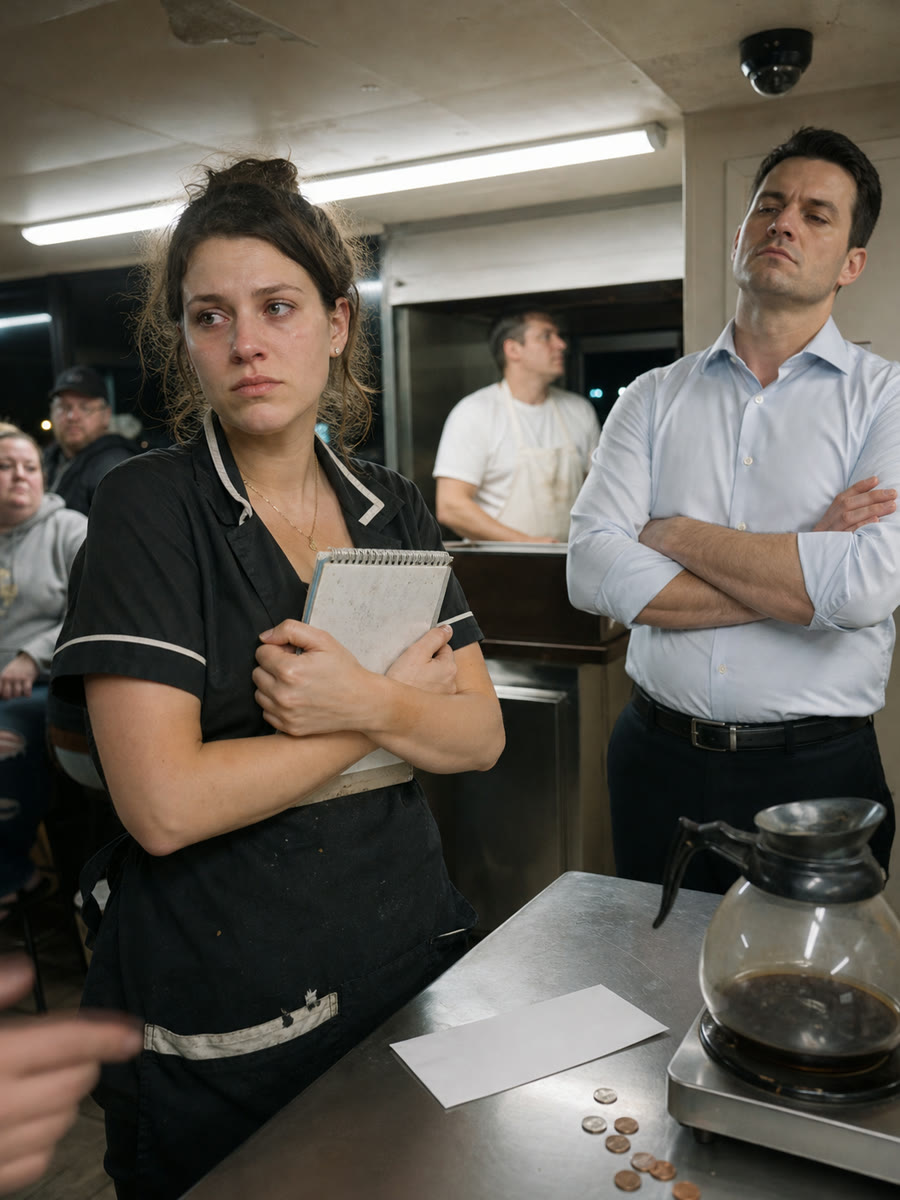
I make $2.13 an hour on the graveyard shift, and the new manager told the whole crew my tips belonged to him
"Tips belong to the house. I decide who gets what. You don't like it, there's a stack of applications in my office."
"Say that again."
"I said what I said, Maddie."
"No, I heard you. I want to make sure I heard the part about you deciding."
"That's the part. That's the whole part."
It was 10:04 on a Tuesday, four minutes into my shift, and I still had my coat on.
Behind me the urn was hissing because Dell had started the first pot early like he always did.
Seven of us between the pass-through and the register. Dell in the kitchen doorway with a towel over his shoulder, Pilar with her apron half-tied, Cody by the bus tubs. Renata, Trish, Wes, me.
"So how does that work," Dell said.
"How does what work."
"The deciding."
"Card tips get processed as a service charge to the house. House holds it. I distribute at the end of the pay period. Front of house, back of house, management. Everybody gets a share of the operation."
"Management gets a share."
"Management runs the operation."
"Management ran it last month too, and last month I got my tips," I said.
"Last month you had a different general manager."
His name was Brent Kessler and he'd been there eleven days. New owners bought the building in March and he came with them. First thing he did was put in a new POS. Second thing was mount a camera.
"How much of a share," Pilar said.
"That's not a number I'm going to stand here and negotiate at ten o'clock at night."
"It's a number though."
"It's a number I decide."
Trish had her hands in her apron pocket. Fifty-eight, a waitress since she was seventeen, and she didn't say anything at all.
"Brent," I said.
"Maddie."
"I get paid two thirteen an hour."
"I'm aware of what payroll says."
"Two dollars and thirteen cents. My check last period was eighty-five dollars and twenty cents before taxes, for forty hours."
"And?"
"And the tips aren't extra. The tips are the wage."
He smiled the way you'd smile at a kid who says something almost right.
"The tips are revenue generated on my floor during my hours of operation."
"It's not your floor. People sit at my tables and hand money to me."
"They hand it to the establishment."
"They hand it to me. I can name them. Table six hands it to me."
"Table six can hand you a kidney, it's still house revenue."
Cody laughed. Cody was nineteen and he laughed when he was scared. He looked at the floor right after.
"Okay," Brent said, and clapped his hands once. "Ten oh six. Somebody's got a car in the lot. Let's go."
*
There was a car in the lot. There was always a car in the lot.
"Two for smoking," the man said.
"Nobody's smoked in here since before I was born."
"Old habit."
"I'll put you in the corner booth. It's the same as smoking except you can't smoke."
"That'll do."
I poured his coffee before he asked. If you don't pour before they ask on nights, you're not paying attention.
"Refill?"
"Please. What time you off?"
"Six."
"Long one."
"Same eight hours as anybody's. It's just at the wrong end."
"Who comes in out here at three in the morning?"
"Everybody. We're the only thing between the ramp and the truck stop eleven miles up. Third shift off the plant. Drivers. Kids at two with four dollars between them ordering one fries and four waters."
"You serve that?"
"I serve that. Cops around four. Nurses about five thirty, coming off, quiet, wanting eggs."
He watched me write on the pad after I cleared his plate.
"What's that, the order?"
"No, the order's done. This is the last page. Date and a number."
"What number?"
"What I made tonight."
"You do that every night?"
"Every night for three years."
"What for?"
"I'm saving for a car."
"You've got a car."
"I've got a car with one working seatbelt in the back and the latch anchors rusted through." I put the pad in my apron. "I've got a four-year-old. Every time I buckle her in I hear the click and I don't trust the click."
*
My mother watches Nora at night. That's the whole reason I work the shift I work.
She cleans at the medical park from seven to three thirty. I get home after six thirty, she leaves at six forty, and Nora sleeps through the handoff and doesn't know there was one.
"She ate a whole banana," Mom said that morning, coat already on.
"A whole one?"
"Whole one. She called it a boat."
"She calls everything a boat."
"How was it."
"It was fine."
"Maddie."
"It was fine, Mom. Go, you're going to hit the light wrong."
I'm not somebody who tells her mother things. She's raised two children and half of a third, and she's tired the exact way I'm tired, and I'm not handing her one more thing to hold.
*
Wednesday, 10:20, he had us all by the register again.
"New sheet. Everybody initial it."
"What is it," Wes said.
"Acknowledgment of the revised gratuity policy."
"You want me to initial that you're taking my tips."
"I want you to initial that the policy was communicated to you. Whether you agree with it is not a box on the form."
"That's a hell of a form."
"Wes, initial the form."
Wes initialed the form. Wes has two kids and a truck payment.
"Maddie."
"I'd like to read it first."
"Read it."
It said the establishment would apply an administrative service charge to all card transactions, that the charge was property of the establishment, and that distribution of any portion was at management's sole discretion.
"It says the charge is the property of the establishment."
"Correct."
"That's not a tip then."
"That's the point. That's why it's structured that way."
"So when the customer hits twenty percent on the screen and the screen says TIP, and they think they're tipping me."
"The screen says what the software says."
"You could change what the software says."
"Why would I do that."
"So it's not a lie."
He looked at me for a second and I watched him decide I wasn't worth the second.
"Initial the form, Maddie."
I initialed the form. Then I rolled my forty of the hundred and fifty and didn't say anything else that night.
*
Cody had been on nights three weeks and still cut the pies wrong.
"Six," I said. "Not eight."
"Eight's more slices."
"Eight's eight skinny slices, and a man at four in the morning looks at a skinny slice and orders nothing."
"Okay."
"And the first one out of a fresh pie's going to tear. That one's yours. Eat it at four."
"I can just eat it?"
"You can eat the one you tore. You can't tear one on purpose."
"How would you know?"
"Cody, I've been doing this three years. I'll know."
He cut six. He tore the first one.
"Now marry the ketchups."
"Marry them."
"Almost-empties into the not-quite-fulls. That direction, never the other way."
"What's the difference?"
"A fly in a bottle by Friday."
He lined the bottles up on a tray.
"Maddie, can I ask you a dumb one?"
"Yeah."
"Why do we roll a hundred and fifty sets? There's four people in here."
"Because the day girls come on at six, and if there's no silverware they're rolling it in the weeds with a full dining room."
"That's not our problem."
"It's exactly our problem. They leave us a clean urn and a full pie case, we leave them silverware. Nobody wrote that down anywhere."
"And if they stop?"
"Then you find out real fast what kind of building you're in."
He rolled silverware a while.
"Eighty-five twenty," he said.
"What?"
"That's my check. For forty hours. I thought it was a mistake the first time."
"It's not a mistake. Two thirteen an hour."
"So the tips aren't extra."
"Cody." I put a ticket on the rail. "The tips are the wage. That's not complaining, that's the arrangement. The eighty-five dollars is a rounding error on a stub."
*
The camera went up on day six, before the tip thing.
Black dome, the half-globe kind, mounted directly above the coffee station, which is the busiest four square feet in the building because everybody passes through there.
He was proud of it. That's the part to be clear about.
"That's a four-K dome," he told us, standing under it. "Audio too. Ninety-day retention on the recorder in the office."
"Why do you need audio in a diner," Pilar said.
"Because I want to know what's happening in my building."
"You could just be in your building."
"I am. Now I'm in it at three in the afternoon too."
He tapped the dome with two fingers.
"I can see everything from here. Everything. Anybody's got a problem being watched doing their job, that tells me something about how they're doing their job."
Trish said one thing that night.
"My whole life I've been watched doing this job. Y'all just finally bought a machine for it."
Brent laughed like she'd agreed with him.
*
The poster by the time clock flapped when I punched in Thursday, same as always.
"That thing's been doing that since I started," Wes said behind me.
"Lamination came unstuck."
I pressed it flat with my thumb. It curled forward again before I got my hand away.
"What even is it?"
"Employee rights. Minimum wage, phone number."
"You ever read it?"
"No."
"Me neither."
"Wes, I've stood in front of that poster five nights a week for three years."
"And?"
"And I couldn't tell you one word on it."
*
The first pay period under the new system came out on a Friday.
"Eighty-five twenty gross," Renata said in the back, holding the stub. "Then the service charge distribution."
"How much."
"Two hundred and six. For two weeks."
"What did you make in tips those two weeks."
"I don't know. I don't write it down."
"Guess."
"Six? Six fifty?"
"So it's less than half."
"I don't know what the math is supposed to be, Maddie."
That's what he was counting on. Nobody knew what the math was supposed to be. He'd taken the number that used to be cash in your hand at six in the morning and made it a line item on a stub two weeks later, and once it's a line item you can't check it against anything.
Except I could.
*
I sat in my car in the lot after that shift with the notepads, and Pilar knocked on the window.
"Get in a second."
She got in. Sodium lights through the windshield, that orange that makes everybody look sick.
"What are those?"
"My notepads. Every night, date and what I made. Three years." I flipped to the back page. "Last three months, before he started. What's my average look like to you?"
She ran her finger down the column.
"Ninety-six a night?"
"Ninety-six. Five nights."
"That's four eighty a week."
"Which sounds like money until you take out gas and the sitter and the fact that a day off is a day with nothing in it."
"And now?"
"Now I'm getting back about seventy-seven a night's worth."
Pilar was quiet.
"That's nineteen dollars," she said.
"Nineteen twenty. Twenty percent off the top, before anybody gets distributed anything."
"Times five."
"Ninety-six a week. Same as one whole night."
"He takes a night off you every week."
"Every week. Seven of them so far."
"And if nobody stops him?"
"Ninety-six a week is five thousand a year, Pilar."
She looked at the notepad, then past me into the back seat where the car seat was, and she didn't say anything, and I put my hand on the latch anchor I don't trust and didn't either.
*
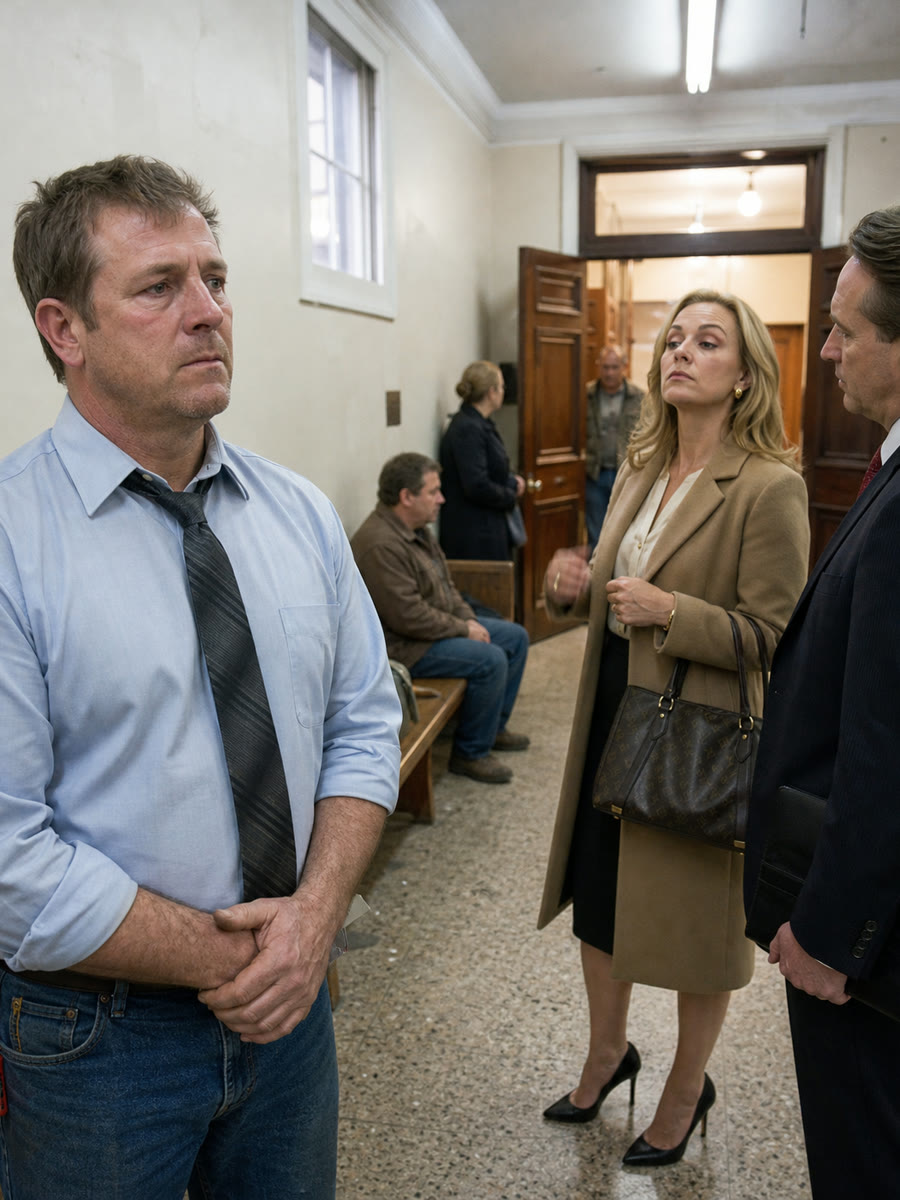
Saturday, 11:40, I asked him in the office with the door open, which I did on purpose.
"Brent, what's the management share."
"Why."
"So I can check my stub against my own records."
"Your own records."
"I keep track of what I make. Every night for three years."
He leaned back. On the desk behind him a monitor showed a four-way split of the dining room, and the coffee station was the top right quadrant.
"Maddie, I'm going to give you some advice."
"Okay."
"Don't do that."
"Don't keep track?"
"Don't audit your employer. It doesn't end how people think it ends. It ends with you looking like a problem and problems get scheduled off."
"I'm not auditing anybody. I'm asking a number."
"And I'm telling you the number is at my discretion, which means it doesn't have to be the same twice, which means there's nothing to check it against. That's not me being cute. That's how discretion works."
"So I'm not allowed to know what percentage of what I earned you're keeping."
"It's not what you earned. That's the part you keep skipping."
"I'm going to ask you one time to think about this."
"Think about what."
"Whether you actually want to do it this way. I'm not threatening you, I don't have anything to threaten you with. I'm asking you to think about it, and I'm going to remember that I asked."
"Is that supposed to scare me?"
"No. It's supposed to be on the record that I asked nice first."
He laughed. He actually laughed.
"Go check on your four-top."
*
Then he made a mistake and the mistake was Trish.
Nineteen years in that building, bad hip, worked the counter and the four booths nearest it. She never took the big station because she couldn't do the distance, and everybody covered for her without ever calling it covering.
He cut her to two shifts.
"Two," she said. "Brent, I've had five shifts a week since before you were out of high school."
"Coverage is based on productivity metrics now. The new system tracks covers per server per hour."
"I work the counter."
"I know what you work."
"Counter's four seats and a stool row. There's no covers to turn. Put a fast girl on that counter and she'd have the same number I've got."
"Then the number's the number."
"That number's the seats. It isn't me."
"Trish, I've got a labor target from the district office and I'm four points over."
"So you found the oldest one."
"I found the metrics."
Pilar put a plate down at the pass-through harder than she needed to.
"Say it in a way that's true, Brent."
"Excuse me?"
"Say: I have to cut hours and I picked the person who can't get another job."
"I'm not going to have this conversation on the floor."
"You have every other conversation on the floor."
He walked back to the office and shut the door that time.
Trish sat in the corner booth and rolled silverware for twenty minutes without talking to anybody, and Cody sat across from her and rolled silverware too and didn't talk either, and that was the smartest thing I ever saw that kid do.
*
There is a man who comes in at 4:15. Ray. He drives a route for a linen company and he's been coming in since before I worked there.
Two eggs over medium, wheat toast, no meat, coffee. His check is $8.16 with tax. He puts down a ten and a five.
"Keep it."
"Ray, that's almost seven dollars on an eight-dollar check."
"Keep it."
"You do this every time."
"And every time you say something and every time I say keep it, so we could save ourselves the trouble."
Cash. Always cash, for years.
The Tuesday after Trish got cut, he put down his ten and his five and I said something I hadn't planned to say.
"Ray, can I tell you something and you not make a thing of it?"
"Depends what it is."
"If you'd put this on the card, I'd get about five and a half of it."
He set his coffee down.
"Come again."
"Card tips go to the house now. New GM distributes them. He takes a cut."
"He takes a cut of your tips."
"He calls it a service charge."
"Maddie, that's not a service charge. That's my money that I gave to you."
"I know."
"I've been handing you a five for four years and a man in an office gets a piece of it."
"Only on the card. Cash he can't touch, so far."
Ray sat a minute. He's about sixty-five and his face doesn't do much.
"Is that legal?"
"I don't know."
"You don't know?"
"No."
"How do you not know?"
"Ray, I'm twenty-six, I have a four-year-old and I sleep from seven in the morning to one in the afternoon. When exactly do you think I looked it up?"
He put his hands flat on the table.
"Well. Look it up."
"And if it's legal?"
"Then you'll know that."
*
I looked it up on my phone in the walk-in at 4:40 in the morning.
Pilar came in for a case of lemons and found me on a milk crate.
"You're going to freeze."
"Read this out loud. I want to hear somebody say it."
She took the phone.
"'An employer may not keep any portion of an employee's tips for any purpose.'"
"Keep going."
"'Including managers and supervisors. Regardless of whether the employer takes a tip credit.'"
"Regardless."
"'A manager may keep only tips he receives directly from a customer for service he directly and solely provided.'"
"So if he waits a table himself."
"Then that one's his. That's the whole exception, Maddie. That's it."
"What year."
"Two thousand eighteen. Congress put it in."
"So it's not a gray area."
"It's one sentence."
She scrolled.
"There's a phone number. Wage and Hour Division, Department of Labor." She looked up. "You can file a complaint. Free. You don't need a lawyer."
"There's no way it's free."
"It says free. It says they keep your name confidential and it's illegal for him to fire you for filing."
"Come out here with me."
We went to the time clock and I stood in front of that peeling poster for the first time in three years and actually read it.
It's on there. Tips are the property of the employee. The phone number's on there too, in a box.
"It's been on this wall the whole time," Pilar said.
"Five nights a week for three years."
I pressed the corner flat with my thumb and it curled forward again.
*
"Dell."
"Yeah."
"How long you been here."
"Eleven years in October."
"Can I ask you something."
"You can ask."
"Under the new system, are you up or down."
Dell scraped the flat top and didn't answer for a second.
"I'm up."
"Okay."
"That's the thing, right? I'm up. I never got tips. Now I get a piece. Kitchen gets a piece. So on paper I'm supposed to be happy."
"Are you."
"Maddie, eleven years on that line and you know what I make? Sixteen an hour. So no, I'm not going to sit here and tell you I don't want the extra eighty bucks."
"I'm not asking you to."
"But here's what I keep chewing on." He put the scraper down. "He didn't pay me more. He paid me with your money."
"Yeah."
"Took it off you, handed it to me, and now if I say something I'm the guy giving eighty bucks back."
"That's what it's designed to do."
"I know what it's designed to do. Forty-four years old, six general managers. I know exactly what it's designed to do."
He leaned on the reach-in.
"What do you want."
"I want to know what he takes off the top before any of it gets distributed."
"You think it's a number he wrote down somewhere?"
"I think it has to be. It's payroll. It has to be a number in a system."
"Then it's in the office."
"Yeah."
"And you're not going in the office."
"No. I'm not going in the office."
*
Here's the part I've gone over the most, because it's where he could have stopped.
Thursday, 11:15, slow. Pilar had a two-top, I had nobody, Cody was cutting pies.
Brent came out of the office with the printouts.
"Team meeting. Two minutes. Coffee station."
Coffee station. Under the dome.
I did not put him there. He picked that spot every time he wanted to say something to all of us, because it's the middle of the building and everybody can hear you. And because I think he liked standing under it.
"So there's been some chatter," he said.
Nobody said anything.
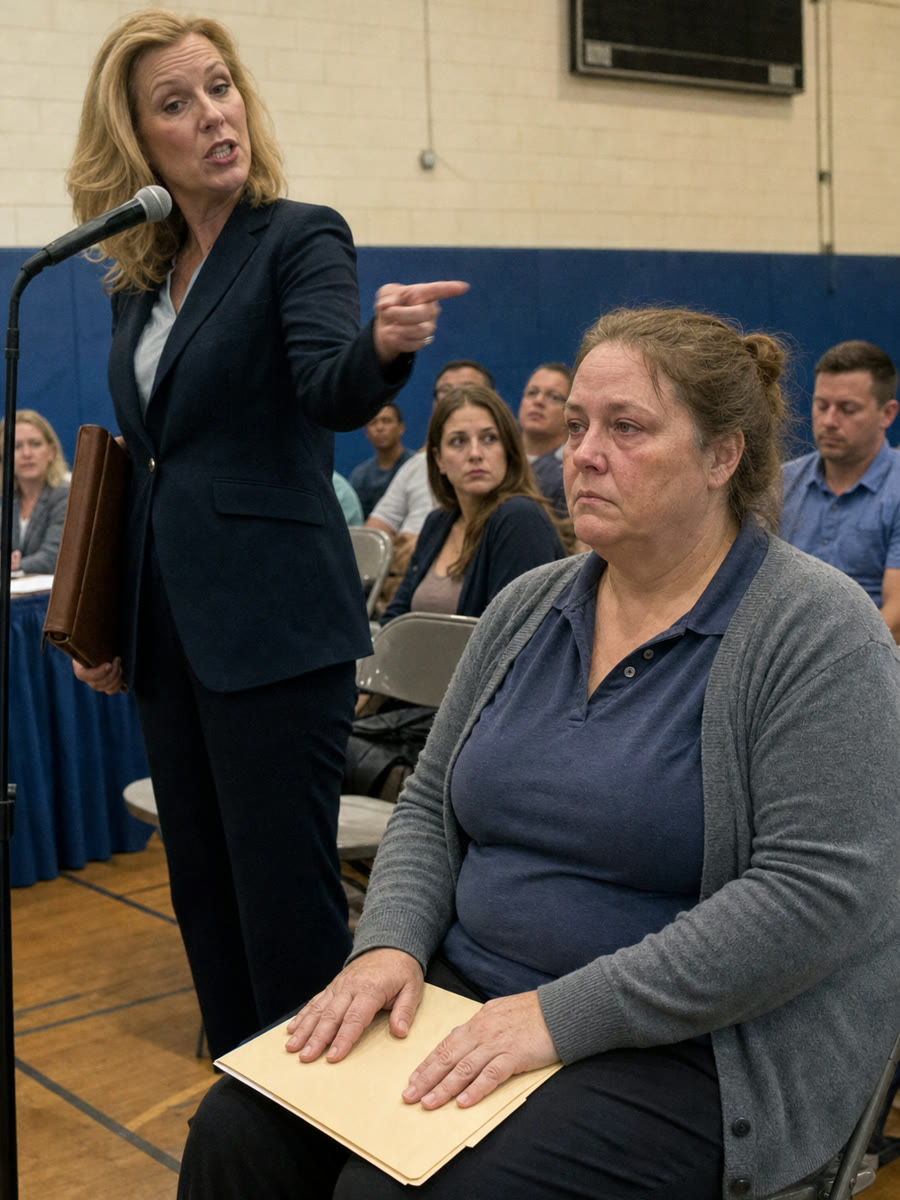
"I'll address it once. Renata came to me about her stub. Wes said something to Dell. Somebody's been talking about percentages."
"People are allowed to talk about their pay," Pilar said.
"People are allowed to do a lot of things right up until it affects the operation."
"Brent, what's the percentage," I said.
"Excuse me?"
"Say it out loud and it's over. You say the number, everybody checks their stub, and if the math works nobody says another word."
"I'm not doing that."
"Why not?"
"Because I'm not accountable to you. That's the actual answer. I'm accountable to a district manager and a labor target and a P and L, and you're accountable to me."
"I'm asking what happened to money that customers gave me."
And that's where he did it.
He put the printouts down and stepped forward, right up under the dome, close enough that Cody had to move.
"Let me be extremely clear one time so we never have to do this again."
He was loud on purpose. He wanted the back to hear.
"Every dollar that comes into this building comes into MY building. There is no such thing as your money in here. It's the house's money and I am the house. The tip line, the service charge, all of it comes to me first and goes out how I say."
"That's what you're saying," I said.
"That's what I'm saying. I take twenty percent off the top before anybody gets a dime, because I run the schedule, I run the labor, and I eat it when the numbers are bad."
"Twenty percent."
"Twenty. Write it down if you want, I don't care. And before somebody gets an idea, I know exactly what's said in my building. That camera's got audio and I watch it. So if you've got something to say about how I run my floor, say it to my face or say it in the lot, because in here I hear everything."
He tapped the dome. Two fingers. Same as the first night.
"Everything."
Cody looked at me.
I looked at the floor. My ears were hot, and my first feeling was not triumph. It was that I was going to have to do something now, and I was tired, and I didn't want to.
"Anything else?" he said.
"No," I said.
"Good. Pilar, your two-top wants a check."
*
I didn't say anything for four days. I've heard people say they'd have done it that night. Those people don't have a mother whose whole week is built around one shift at one building.
For four days I poured coffee, rolled silverware, said good morning to Ray at 4:15, and signed the closing checklist by the walk-in.
On the fifth day I called the number off the poster, from a parking lot at two in the afternoon, with Nora asleep in the back in a seat I didn't trust.
A woman answered. Every question she asked was about a document.
"Do you have your pay stubs?"
"Yes."
"Do you have any record of your tips independent of the employer's records?"
"I have three years of notepads."
"You have what?"
"I write down what I make every night. On the notepad I take orders on. Date and the number."
"Every night?"
"Every night for three years."
There was a pause.
"Ma'am, that's better documentation than I usually get from people with lawyers."
I put my hand over my mouth so I wouldn't wake Nora.
*
"Can I ask you some things," I said.
"That's what I'm here for."
"He calls it a service charge. Does that make it one?"
"Not by itself. If it's presented to the customer on the screen as a gratuity for the server, calling it something else in a policy document doesn't change what it is."
"So the name doesn't matter."
"The substance matters."
"And if it's tips, he can't have any of it."
"A manager can't retain any portion. Not through a service charge, not through a pool, not through any mechanism."
"Does he owe us on the hourly too?"
"Only where what you actually received falls under the credit the employer is taking. From what you're describing it doesn't. What he owes you is the tips."
"What happens if you find that."
"The remedy starts with the money back. In many cases we also seek an equal amount in liquidated damages."
"Equal amount meaning double."
"Meaning the back wages, and then that same figure again."
"And if he knew it was illegal when he did it?"
"Then it's willful, and the period we can look back at goes from two years to three."
"He'll know it was me."
"He won't get your name from us. That's confidential."
"He can guess."
"He can guess. If he acts on the guess, that's retaliation, a separate violation, and we pursue it."
"You pursue it."
"We pursue it. You don't have to sue him yourself."
"How many employees are affected?" she asked.
"Nine of us."
"Are any of them willing to be named?"
"I don't know."
"You don't need them. One employee's complaint can open an investigation of the whole establishment."
"But it's better with more."
"It's not required. It's just harder for an employer to call it one disgruntled person."
"Yeah," I said. "I've met that one."
*
I asked them one at a time in the walk-in, because the walk-in has no camera.
Dell first.
"You're doing it?"
"I'm doing it."
"With the notepads."
"With the notepads."
"How much is he into you for?"
"Seven hundred sixty-eight dollars."
"Say that slower."
"Nineteen twenty a night. Five nights. Ninety-six a week. Eight weeks so far. Seven hundred sixty-eight dollars. And it goes up every Sunday."
Dell stood there in his apron and did that math in his head, and I watched him get to the end of it, and something in his face changed.
"That's the brakes and the tires."
"That's a car seat that latches."
"Maddie."
"Put my name on it."
"Dell, you're up under his system. You lose money if this works."
"I'll say this once and then go turn my eggs." He pointed at the door with the scraper. "He made me take money out of your kid's mouth and made me feel good about it for two weeks. He can have his eighty dollars back. Put my name on it."
*
Pilar didn't need to be asked.
"I already looked it up," she said. "The night he tapped the camera. I looked it up in the parking lot before I even got in my car."
"You've known for a week."
"A week. I sat on it because I've got a green card interview in March and I've spent four years being extremely careful, and I've been going back and forth on whether this counts as careful."
"Pilar, you don't have to."
"Let me finish. I called my cousin. She's the accountant, she's the one who does everything right in our family. You know what she said?"
"What."
"That this is exactly the kind of thing they want you to think you can't do."
She tied her apron.
"Put my name on it."
*
Renata took the longest.
"If it's confidential why does he need names at all."
"He doesn't. They keep names confidential from him. The names are for them."
"But he'll know. Nine people file, he'll know."
"Probably."
"So confidential doesn't mean anything."
"It means he can't get a list. It doesn't mean he can't guess."
"Then what's the point?"
"The point is if he fires you for guessing right, that's a second thing they get him for, and that one he can't argue."
Renata looked at the shelf of green beans for a while.
"My mother cleaned rooms at a motel nineteen years," she said. "They stole from her constantly. Little amounts. She never said a word because she thought that's what having a job was."
"Yeah."
"She's dead now and I'm still mad about it." She wiped her hands on her apron. "Okay. Yes."
*
Wes said yes in about four seconds and then went and threw up in the employee bathroom.
"I'm good," he said, coming out.
"I know."
Neither of us mentioned it again.
Cody said yes, then said, "Will they call my mom?"
"No."
"Okay. Because she'd freak out."
That was the whole conversation, and he was the first to write his name down.
Marisol works Fridays and Saturdays. She said yes on the phone in nine words.
Hector, who runs the dish pit, said yes and then said, "Tell them about the water heater too."
The water heater had nothing to do with anything. He'd been waiting three years for somebody to ask him a question.
That was eight.
*
Trish said no.
I asked her in the corner booth at 3 a.m. with a bin of silverware between us. She listened to all of it without interrupting once, which is its own kind of respect.
"No, honey."
"Trish."
"I'm going to tell you why, and I want you to actually hear it, not just wait for me to finish so you can talk."
"Okay."
"I'm fifty-eight. I have a hip that's bone on bone and I can't have it done until January because that's when the coverage kicks in under the new owners. Nineteen years I've been here and the one thing I've got out of nineteen years is that in January somebody's going to fix my hip."
"He can't fire you for filing. That's the law too."
"Baby, I know what the law says." She set down a fork. "It says he can't fire me for filing. It does not say he can't find something else. In nineteen years I've seen four people fired for something else, and every one of them made somebody uncomfortable about three weeks before."
"So he wins."
"No. You go win. I'm telling you to go win." She pushed the bin toward me. "I'm telling you I can't be in the picture when you do it, and that's not the same as telling you not to."
"How much has he taken from you," I said.
"I don't want to know."
"Trish."
"I do not want to know, Maddie, and I want you to respect that. If I know the number I've got to decide what to do about it, and right now not knowing is the only thing letting me come in here five days a week." She stopped. "Two days a week."
"Two days a week."
"Two days a week." She picked up another fork. "And here's the other thing. If it works, I get mine anyway, don't I. You said they look at the whole place."
"They look at the whole place."
"So the girl with the bad hip gets paid because eight other people put their names on something." She rolled the fork into a napkin. Her hands were steady and mine weren't. "That's a hell of a thing to accept about yourself at fifty-eight. I'm going to accept it, and I don't need you to make it okay."
"I wasn't going to."
*
Then Ray made nine, except not on the complaint, because Ray's a customer.
Thursday at 4:15 he sat down and I brought the coffee and he pulled a folded piece of notebook paper out of his shirt pocket.
"What's this."
"Read it."
It said: I have eaten breakfast at this diner approximately three times a week for four years. I have always paid cash and I have always left a $6.84 tip on an $8.16 check, and I have always intended that money for the server, not the business.
Then his name, printed and signed, and a phone number.
"Ray."
"Called my nephew, he does insurance. Said a statement's a statement, doesn't matter who writes it."
"Six eighty-four."
"Ten and a five, minus eight sixteen." He shrugged. "It ain't a hard one."
I stood there with a coffee pot in my hand at four fifteen in the morning.
"Sit down a second."
"I can't, I'm on the floor."
"Maddie, there's two people in here and one of them's asleep."
I sat down.
*
The eight of us signed on a Tuesday, in Pilar's car in the lot, which is the least dramatic possible place to do anything. Cody spelled his own last name wrong and had to cross it out and initial it.
I had the notepads in a grocery bag. Three years of them.
"That's all of them?" Dell said.
"That's all of them."
"You never threw one away?"
"I was saving for a car. I liked adding them up."
The investigator had asked me one more thing on the phone, and it's the thing that made everything else work.
"You said there's a camera."
"Yes."
"Where."
"Directly over the coffee station. Ceiling dome. Audio."
"And he made the statement about the twenty percent where?"
"Standing under it. He tapped it while he was talking. He told us he watches it and hears everything said in the building."
There was a pause, and it was the only time in the whole process that woman's voice did anything at all.
"Ma'am. How long does that system retain?"
"Ninety days. He told us that too. He was proud of it."
*
They came on a Tuesday afternoon. I'd gone back down.
Pilar texted at 3:40, *they're here*, nothing else, and I lay there and looked at the ceiling.
What I know I know from Dell, who was on and who tells a story in order without embellishing.
Two of them. They asked for the manager, showed identification, and asked for payroll, time records, POS reports and the gratuity policy.
"He gave them everything," Dell said. "Right away. Boxes."
"He wasn't fighting it?"
"Maddie, he thought he was fine. That's the part you've got to understand. He walked them into that office like a man showing off a garage."
In his head he hadn't stolen anything. He'd restructured a revenue line. He had a policy document and a signed acknowledgment from every one of us, mine included.
"And then?"
"And then the guy asked him to walk them through the twenty percent management retention."
"He said it like that?"
"Exactly like that. And Brent, I swear to God, Brent goes, 'Who told you twenty.'"
"Oh."
"Yeah. And the guy just let that sit."
They asked about the camera during the walk-through. Standard, they said. They wanted to know where the tip pool was physically handled and whether cash got counted on site.
"He showed it to them," Dell said. "Walked them out to the coffee station, pointed up at it, gave them the whole thing. Four-K, ninety-day retention, audio."
"He volunteered it."
"Maddie, he was bragging. Eleven years here and I've never seen a man walk into it that clean."
"What did they say?"
"Nothing. That's what killed me. The lady wrote something down, then asked if it was currently retaining the last ninety days, and he said yes, and she asked him to preserve it and not overwrite anything. Then she asked him whether the staff had been told that camera recorded sound. He said he told us the day he mounted it. She wrote that down too. And I watched his face do a thing."
"What thing?"
"The thing where a guy works out what he just did about four seconds too late to unwork it."
*
He knew by Thursday. Not who. He never got a list and as far as I know he never will. But he knew.
I came in at ten and he was standing by the register.
"Maddie."
"Hey."
"You got a minute."
"I'm on in four minutes."
"It'll take two."
We went to the end of the counter, not the office. He did not look like a man who'd lost yet. He looked like a man managing a situation.
"I want you to know I'm not angry."
"Okay."
"I understand why people did what they did. There was a communication failure on my part."
"A communication failure."
"I rolled out a policy without explaining the reasoning and people filled the gap with the worst version. That's on me."
"Brent, the gap was the twenty percent."
"The twenty percent was a labor allocation."
"It was my money and you put it in your pocket."
"It was a line on a P and L."
"Then say the line out loud."
He didn't.
"Do you know what number I got handed when I took this building?" he said instead. "Twenty-six percent labor. This is a twenty-four hour diner off a ramp with a graveyard that runs forty some weeks, because you need two people on the floor at four in the morning whether there's four customers or forty. I had a district manager on the phone every Monday since the day I took this building asking what I was going to do about it."
"So what were you going to do about it?"
"Make the number work."
"With my tips."
"With a revenue reclassification I was told other buildings in the district were using."
"Was it legal?"
He didn't answer that either, and the silence lasted long enough that Cody stopped cutting pies twenty feet away.
"You could have gone back to the district," I said, "and told them the number isn't achievable in this building on this shift. That's a thing a manager can say."
"And then I'd be a manager who can't hit a number."
"Yes. That's what you would have been."
He looked at me.
"You have a kid, right?"
"Don't do that."
"I'm asking."
"Yes. Don't do that."
"I have two," he said. "So."
"So what?"
"So I'm not a villain, Maddie."
"I don't think you're a villain." I hung up my coat, because it was ten and time to work. "I think you took a thousand and fifty-six dollars from me and you had a reason. Those aren't opposite things."
*
They came back three weeks later.
By then he'd killed the service charge. He announced it by email at 11:40 on a Sunday night, to people who mostly don't have email: a "return to the prior gratuity handling procedure effective immediately." No explanation, no apology, no mention of the eleven weeks.
Pilar read it out loud in the kitchen in the voice of a man reading a hostage statement.
"Effective immediately," Dell said. "What about effective eleven weeks ago."
The findings came in a letter and Dell read it at the counter with his glasses down his nose.
"'Violation of the Fair Labor Standards Act. The employer kept a portion of employees' tips.'"
"Keep going."
"'The arrangement did not constitute a valid service charge, as the amount was presented to the customer on the payment screen as a gratuity for the server.'"
"That's the screen thing," Pilar said. "That's what you told him the first week."
"'A manager may not retain any portion of employee tips regardless of whether the employer takes a tip credit.' Then it says the practice continued after employees raised it in writing, so it's willful."
"Willful," Renata said. "What's that get us?"
"Not the lookback. Eleven weeks is eleven weeks either way. It's why nobody let him talk them down off the double."
"Read the money."
"'Back wages for nine employees, plus an equal amount in liquidated damages.'"
"Nine," I said.
"Nine."
"There's eight of us who signed."
"Trish is in it," Dell said. "They looked at the whole building. She's in it and she never signed a thing."
"She said that would happen."
"She said it word for word."
Mine was one thousand fifty-six in back wages and one thousand fifty-six in liquidated damages.
"Two thousand one hundred and twelve," Dell said. "That's yours."
"Say it again."
"Two thousand one hundred and twelve."
That is not a fortune, and I know how these stories usually go. It's a used car with a back seat a car seat latches into, and about four hundred dollars after, and that's exactly what it turned into and nothing else.
Trish's was the biggest, because she had nineteen years of regulars who tipped her on cards.
She read her number at the counter, since she'd said she didn't want to know.
"Well," she said.
Then she went and got the ketchups.
*
Brent wasn't fired. I think people expect that part, and it didn't happen.
The owners kept him through the end of the quarter and then he transferred to another building in the district, and the notice on the corkboard said he was "taking on an expanded role."
Dell laughed for about a full minute at that one.
"Expanded role," he said. "They expanded him right out the door and gave him a nice hat on the way."
"It's not enough," Renata said.
"No. It's not."
"Doesn't that make you crazy?"
"It did for about three days."
"And then what?"
"And then I got the check."
The new GM is a woman named Deb, off a truck stop restaurant two counties over, who has worked every job in a building like this one. Her first week she came in on nights and worked a station, which no GM had done.
She took the dome down her second Thursday.
"Is that legal?" Cody asked her.
"Cody, honey, it's my ceiling."
"He said it was for security."
"It was pointed at the coffee station. Nobody's robbing the coffee station." She handed the mount down to Wes. "Camera on the register, one on the back door, one in the lot. That's where cameras go."
She added one to the lot, because the far end of that lot is dark and there was never a reason it should be.
*
I fixed the poster myself. Packing tape from home, four corners flat, a strip over the curl so it doesn't flap when you punch in.
It looks worse. It looks like something a person taped to a wall.
"What are you doing?" Deb said.
"This corner's been peeling for three years."
"So it has."
And she kept walking.
*
Ray still comes in at 4:15.
"Get your car?"
"I got the car."
"Back seat?"
"Back seat. The latches are metal and they're not rusted and when it clicks, it's clicked."
"That's the whole thing, isn't it."
"That's the whole thing."
He put down a ten and a five.
"Ray, I've been meaning to ask you something."
"Ask it."
"Why six eighty-four? Why not just leave the ten?"
He looked at me like I'd asked why water's wet.
"Because ten's not enough and twenty's showing off."
*
I still write the number down. Same spiral, same last page, date and one number. Ninety-six on a good one, sixty on a slow one, one forty-two the night the plant did overtime.
"Why do you still do that?" Dell said. "It's over."
"It's not for the case."
"Then what's it for?"
"It's for me to know what I made."
He flipped a row of eggs.
"That's a little sad, Maddie."
"No it isn't."
"Little bit."
"Dell, I make eighty-five dollars and twenty cents a week from that company. Everything else comes from people handing me money at a table at three in the morning." I put a ticket on the rail. "Nothing about knowing that is sad."
*
A week after the checks came, Renata was still angry about the transfer.
"He should've had to stand in this building and say it out loud. In front of all of us. Say the number."
"Renata. He did."
She stopped wiping the counter.
"He stood right there and told nine people exactly what he was taking and how much, and he said it as loud as he could so the back would hear."
"Because he thought he was allowed."
"And then he tapped the camera and told us he hears everything said in this building."
"God."
"That's the part I can't get past. Not that he took it. That he wanted us to know he took it."
"You caught him."
"No."
"Maddie, come on."
"I didn't catch anybody. I'm a waitress on nights with a notepad and a four-year-old and a mother who works days." I hung up my coat. "All I did was write down what was mine. Then he told me it wasn't, and I believed him for eleven weeks."
"And then?"
"And then I stopped believing him and called a phone number off a poster from a parking lot."
Renata folded the rag over the rail.
"He built the thing that recorded him," she said.
"Yeah. I just didn't step in front of it."
I clock in at ten. The poster doesn't flap anymore. Dell starts the first pot early because he always has.
There's a car in the lot.
There's always a car in the lot.